Tag Archives: Life

READER COMMENTS (27/7/26)

[The following two thought-provoking comments were made on our previous post by Keshav Vaze and Jayram Daya. The editors felt that these comments should be shared with the wider reader group.]

1. Comment by Keshav Vaze

One line from the post A Few Points On Religion caught my attention in a striking manner:

The established ‘religious institutions’ of Gujarat did not fulfill the simple requirements of basic humanity; a ‘foreign religion’ did.

Naturally one asks, ‘WHY?’

Let me put forth the string of thoughts as an answer to this question. Perhaps we can pin it down to one of the tenets of Hinduism: the idea of rebirth, reincarnation, पुनर्जन्म. 

A long time ago, I had read an article in Marathi on the topic of पुनर्जन्म. I am not sure, but I think it was attributed to Osho. The gist of the article was:

Long long ago there was a civilization, a precursor to Hindu. They faced a dilemma: Teachings of the Shastras suggested that as part of Divine Justice, good deeds fetch rewards, and bad deeds fetch punishment. The reality was palpably opposite. Bad men were flourishing and good men were suffering. Gyanis thought over it. If this continued, and it seemed clear that it would, it would be impossible to persuade people to do good things. Then they played a masterstroke.

They said: ‘Yes, we are witnessing an inversion of the Shastras. But it appears so only during this birth. Your good deeds in this birth will be rewarded in the next birth; and you will be punished in your next birth for all your bad deeds in this birth.’

As expected, this was bought by the public and the good men continued to be good. Happy ending!


What the article did not say was: There is a corollary, or call it a side effect.

That logic made it somewhat easy to ignore the call of the conscience to help the needy. The call was suppressed by the logic that the suffering person must have done something bad in his previous birth, and is being punished for the same in this birth. I should not act against ‘Divine Justice’ by mitigating his suffering.

It also kept the sufferers quiet: Convinced that the suffering is ‘God given’, a consequence of the sins committed by them during their previous birth, they were reluctant to fight against the injustice and preferred to endure the suffering so that they will be rewarded in the next birth.

Unless the society accepts the tenets that ‘Good is good in itself. There is no one sitting in judgement. There is no reward nor punishment: neither in this birth nor in the next birth‘, the society will land into this problem.

2. Comment by Jayram Daya

Your article draws a clear distinction between dharma as an essential principle that sustains life and order and religion as a historical, institutional, and social construct. The two should not be considered synonyms. Dharma is more than just a set of beliefs or a membership identity; it is about the nature of existence, right behavior, accountability, and the order that supports both the individual and society.

However, the Advaitic view holds that the ultimate truth cannot be limited to a single religion, prophet, text or institution. Different traditions might be viewed as culturally conditioned representations of humanity’s search for a single ultimate reality. The true test of any spiritual path should not be its size, power or claims of exclusivity, but rather whether it fosters compassion, humility, self-awareness, and genuine concern for the suffering of others.

THE HIGH COST OF FICKLE UNDERSTANDING

by Naresh Jotwani

Looking back at the major military conflicts since the last century, one sees that none of them produced results which were proudly and loudly touted to be achieved. Failure is the norm, while success has had to be retrofitted into the outcome through clever PR. Examples: the two World Wars, Korea, Vietnam, Iraq, Afghanistan and the current conflicts in Ukraine and the Middle East.

Ordinary people are taken in by tyrants’ sabre-rattling, loud speeches, military parades and so on. An ordinary person says to himself: All that cannot be wrong, can it? Listening to a mesmerizing tyrant, he dare not even articulate the thought that the bravado is hollow and could backfire. But, invariably, it does. Ordinary people need to wake up and smell the coffee. It is not enough to say that the tyrants can be wrong. The fact is they are wrong, and their mistakes prove costly to all.

This post tries to link such failures to fickle understanding.

Continue reading THE HIGH COST OF FICKLE UNDERSTANDING

MUSKOVIA @ 2050 CE

by Naresh Jotwani

It is difficult to make predictions, especially about the futureattributed variously to Nostradamus, Niels Bohr and Yogi Berra.

The year is 2050 CE, and the country is Muskovia, the most prosperous and ‘advanced’ country in the history of mankind. AI has been deployed throughout the country to make up for the huge population decline of the previous decades.

Continue reading MUSKOVIA @ 2050 CE

Evidence of Imbalance (1)

by Naresh Jotwani

When does one understand an aspect of reality?

Example: Projectile motion is an aspect of reality. When projectile motion is modelled in the form of mathematical equations, it can be said that the particular aspect of reality has been understood — that is, a validated conceptual model has been found for it. Projectile trajectory can be calculated, either to explain past data or to predict future results.

That same criterion must be applied to the understanding of any other aspect of reality – namely, the ability to explain the unfolding of real life events.

Continue reading Evidence of Imbalance (1)

SOCIAL WELL-BEING INDEX

by Naresh Jotwani

Soon after the previous post was published on this blog, we came across the definition of a so-called Social Well-being Index (SWI), introduced by a group within Russia. Briefly, the SWI index is based on these criteria: life expectancy, infant mortality rate, homicide rate, total fertility, income inequality, education level.

Continue reading SOCIAL WELL-BEING INDEX

WEALTH AND POWER IN KALI-YUGA

by JAYRAM DAYA

[Editorial note: Consider this ‘eternal mathematical truth’: (a+b)×c = a×c + b×c. A mathematician, centuries ago, must have divined and articulated this truth. Surely however, in commerce, this truth held even in earlier epochs. Suppose you had two bags of fruit, with a given unit price. Then you got the same total price (a) by adding the two weights and pricing the total, or (b) by weighing and pricing the bags separately and then adding the two prices. Surely that bit of commercial truth is also eternal, regardless of what mathematicians say!

Eternal truths are timeless. They held in ages past, hold today and will continue to hold in whatever future we may be heading into. Today Jayram Daya has selected for discussion one such eternal truth; not a mathematical truth, but a societal one, from Srimad Bhagwatam.

Read, reflect and enjoy!]

वित्तमेव कलौ नृणां जन्माचारगुणोदय: ।
धर्मन्यायव्यवस्थायां कारणं बलमेव हि ॥ २ ॥

In Kali-Yuga, wealth alone is considered the sign of a man’s good birth, proper behaviour and fine qualities. Law and justice are applied only on the basis of power.

Shrimad Bhagwatam (verse 12.2.2).

The wisdom of this ancient verse reads less like scripture and more like a headline in 2026. The verse says that in Kali-Yuga,  merit is replaced by the sheer weight of a wallet, and justice becomes a commodity rather than a right.

When we examine the current global landscape, especially through figures like Donald Trump, these truths are not remote or subtle; they are glaring and unmistakable; they have become the defining characteristics of our era.

Wealth as the new definition of virtue

The verse states that wealth alone will be considered the sign of a man’s good birth, proper behaviour, and fine qualities.

Modern society views net worth as a sign of competence.

Consider Trump. His entire political identity has been built on his branding as a ‘billionaire dealmaker’. For millions, his wealth served not merely as an asset but as a moral credential, pre-authorizing his leadership irrespective of his dubious ethical record. The Bhagavatam states clearly that external wealth is mistaken for personal qualities.

Global ‘success’ culture

We see this everywhere, from the glorifying of ‘grind culture’, to influencers who hawk luxury and excess dressed up as insight and wisdom. The elevation of wealth as the sole criterion of ‘good fortune’ results in devaluation of character, and redirection of societal ambition almost exclusively towards  wealth acquisition and ostentation.

Power as the arbiter of law

The second half of the verse is even more striking: Law and justice is applied only based on one’s power.

In 2025 and 2026, we have watched as the legal systems of the world’s most powerful nations struggle to hold the elite accountable. Whether it is through endless litigation, the ‘transactional’ appointment of judges, or the use of political office to bypass indictments, the message is clear: Justice is no longer blind; it now measures worth by the size of one’s balance sheet.

A ‘might-makes-right’ world

International relations have returned to a pure transactional approach. The use of power, financial and military, is now used to unilaterally reshape borders and trade agreements, to the exclusion of any international dharma. When a figure uses his position to ‘rule the world’ through sheer force of personality and purse, the rest of the world often feels silenced, unable to challenge the brute strength, बलम, on display.

Reclaiming the servant

Srimad Bhagwatam does not just diagnose the disease; it reminds us of the cure. The danger isn’t money itself, but its elevation to the status of god. The more money becomes the ‘ruthless master’, the more humans become ‘asses’, in working tirelessly for superficial and meagre rewards.

One way to challenge the Kali-Yuga mindset is to restore the integrity of money. It requires a return to substance over status and dignity over dominance.

Heed the warning

The verse in question does not condemn modernity; rather, it explains modernity. In 2026, the verse reads like a prescient, sober diagnosis of a world of inverted values. Donald Trump’s position of power illustrates how easily wealth can be covered up as virtue and power as righteousness. That is the true meaning of Kali-yoga.

The challenge, then, is not political but civil. Restoring justice depends on reaffirming that money is a means, not a badge of legitimacy, and that power must operate within the law rather than stand above it. Without this correction, the eternal truth continues to unfold, not as prophecy, but as lived reality.

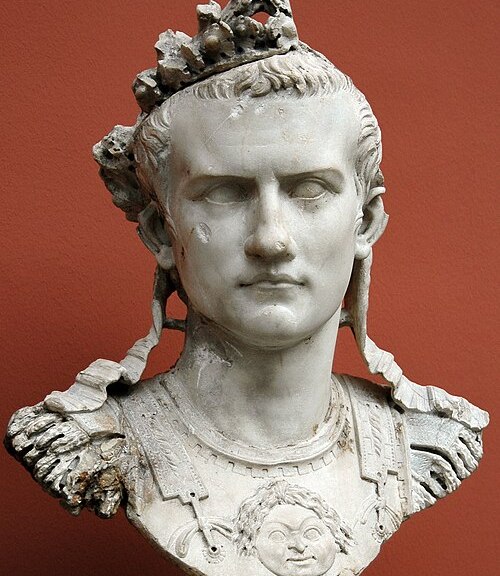
[Image: Bust of Emperor Caligula of Rome; photograph by Sergey Sosnovskiy; courtesy: wikimedia]

Two Powerful Words

by Naresh Jotwani and R. Srinivasan

Should I try to be a moral person? A nice guy? A law-abiding citizen? Or would that turn me into a loser? An impractical dreamer?

How do I become a winner? A realist?

Can I become a cunning operator in a philanthropist’s garb? Is that option available to me? Or only to some billionaires? Is greed really good – as they say on Wall Street?

Questions, questions … and more questions! But – alas! – no clear answers!

In the hope that a discussion around such questions would be of interest to everyone, we attempt here an exploration of some basic issues.

Continue reading Two Powerful Words