by Naresh Jotwani
At first sight, one may be forgiven for thinking that ‘civilized’ means well-behaved, wise, educated … or some nice-sounding combination thereof. A little reflection, however, shows that the word is not so well-defined.
Some time back, Washington Post ran an op-ed entitled Civilized nations’ efforts to deter Russia and China are starting to add up. The phrase ‘civilized nations’ in this context has undisguised, in-your-face geopolitical motivation, the clearly intended implication being that Russia and China are not civilized, whereas ‘we’ are. (See Note 1).
The word deter in that title also merits some attention.
One must assume that, in geopolitics, it is ‘just another day at the office’ for one power to attempt to deter another. If two powers are in a state of unstable equilibrium, but not openly at war, attempts to deter one another would go on. Such is life. Certain lines – red or another colour – must not be crossed, weighty pronouncements must be made, and ‘swords must be banged against shields’. All this is standard stuff which foreign office trainees must learn, and upon which depend their perceived performance and career growth.
Clearly physical power is the one deterrent we all know about, starting from our experiences in the school playground. But what has ‘being civilized’ got to do with deterrence? That combination makes you wonder.
Surely one would be deterred by a big guy carrying a big stick – regardless of whether or not he seems to be ‘civilized’. In the same way, one is also deterred by a growling dog – whether or not the dog is fed and groomed by a ‘civilized’ owner.
Chengiz Khan attacked other countries with brutal physical force, without any claims of possessing ‘higher civilization’. Before the sack of Rome, Alaric behaved far more sensibly than the ‘civilized’ ruling elite of Rome.
Indeed a vibrant, creative civilization attracts others, does not deter them. A few centuries ago, the Indian civilization attracted scholars from other regions. If a ‘civilization’ is aiming to deter others, then what happens to all the grandiose talk of ‘civilizational values’? That does not add up.
Mao said: Power flows through the barrel of a gun. But do culture and civilization also flow through the barrel of a gun? Throughout history, have the ‘civilized’ always won their wars? How do we explain the recent history of Afghanistan? Which ‘civilization’ finally gained the upper hand there? What did the ‘civilized nations’ of NATO achieve there? Whom did they manage to deter? For how long?
One simply cannot make any sense of claims of being ‘civilized’ thoughtlessly tagged to the military condition known as ‘deterrence’.
What follows is a brief history of how the world has got into this conundrum. It is not a work of ‘academic scholarship’, but rather it connects various dots discovered by scholars. The connections are based on the play of human nature we see all around us, 24×7, in any country.
The word ‘civilize’ derives from the Latin root civis, meaning citizen, and thus it is predicated on the idea of a ‘city’. Nomadic tribes of a period earlier than, say, 10,000 years ago would not have such a word in their language, while of course the concept of ‘fellow tribesman’ would be understood very well.
The earliest cities were in fact trading centres for the surplus primary produce of nearby hamlets and villages. Trading – that is, sensible economic exchanges – happened long before the invention of writing and of money. People were wise even then, perhaps wiser than they are now.
Trade generated surplus wealth. Thus people in cities – that is, traders of one sort or another – were free to explore aspects of life other than the onerous work of primary production. Philosophy, religion, politics, finance, law, ‘higher’ arts and literature … all these flourished. Individuals in the city cultivated themselves, while their fellow human beings ‘out there’ cultivated the land. Paeans and hymns were dutifully sung to the glory of the city and her various ‘gods’.
It was not long before the cultivated ones thought of themselves as ‘superior’ to the hard-working, simple folk ‘out there’. In any one-on-one interaction with a simpler human being, a cultivated person could easily run circles around the latter – and probably also charge a fee for that service.
Aided by writing and money, the political power of cities grew, reaching a point at which cities declared themselves to be ‘proud city states’. Thence arose class distinction between ‘civilized’ city dwellers and the rustic population outside, which was by then economically and politically dependent on the cities. City states eventually grew into empires, following the all-too-familiar dynamic of unlimited human arrogance, greed and brutality.
The simpler rustic folk were divided into ‘subjects’, ‘serfs’, ‘slaves’ … and so on. When organized groups of the rustic folk got into friction or warfare with the ‘civilized’ ones, they were dubbed ‘barbarians’. This type of phenomenon has played out repeatedly in recorded history. It is grounded in economic motivations, and therefore it also has huge economic consequences.
Before ‘civilizations’ came into being – and therefore before the invention of money and writing – the relationships between primary producers and traders were simple and direct, as depicted below.

Even huge geographical distances could not block trade, since ships and caravans could be used. Traders were brave and ingenious. For probably a couple of millennia, mankind experienced a ‘golden age of trading’, during which benefits of trade accrued — but without cruel economic exploitation, slavery, human trafficking and such other evils.
Things changed after the emergence of money, writing and ‘civilizations’. Multiple layers of political, social, financial, legal and other services emerged, giving opportunity to every ‘citizen’ to climb the hierarchy of choice, depending on his or her aptitude and talent. Of course the two most useful talents would be greed and cunning – but clearly any other talent could be put to such use, for example physical beauty, or the ability to declaim in public.
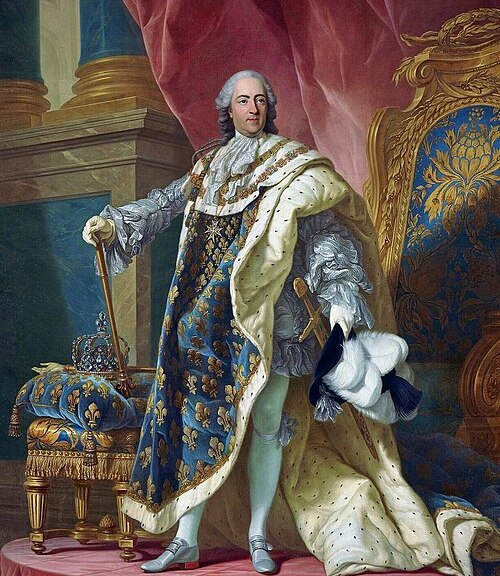
Since then, members of the ‘civilized elite’ of all ‘civilizations’ have wanted to get into the act and take their juicy cut. The main goal of such ‘civilized elite’ is to grab every chance for easy money, with the view made infamous – relatively recently – by the French king Louis XV: After me, the deluge! (The king appears in the featured image above).
The situation has evolved – or devolved! – to the stage that primary producers have become the weakest segment of a ‘civilized’ society. Those higher up in the ‘civilizational pecking order’ – puffed up with their wealth, connections and self-importance – make ‘profound’ pronouncements about ‘civilization’ or ‘the common people’. Politicians, oligarchs, top bureaucrats, their lackeys … et cetera … are deemed to be the most ‘civilized’, and primary producers the least.
‘Civilized’ has thus become a label to be used for social or political aims, in the game of egos, power and wealth. Primary producers are seen as ‘uncivilized’, ‘deplorable’ … et cetera. The word ‘civilized’ also serves as a useful cover for individual failings. A wife-beater in private, for example, may be feted in public as ‘an unshakeable pillar of our proud civilization’.
So much for the word wrongly used in the Washington Post article.
Can we look for a meaning of the word ‘civilized’ which is NOT related to its Latin root? After all, a couple of thousand years separate us from the peak of the Roman empire, and words do change their meaning with time.
Today, thanks to global travel, education, commerce and – most of all – the internet, the world has become intellectually unified. We live in one giant city, and every human being is a citizen. The old Roman meaning of the word, applied logically, would imply today that every human being is by definition ‘civilized’, simply by virtue of living in this one large city.
But human behaviour spans a huge variety, from the noble to the unspeakably horrific. One would like the word ‘civilized’ to mean something positive. Loud, foul-mouthed behaviour, or wife-beating, as just two examples, should not be seen as ‘civilized’.
Buddha and other sages have described these as good qualities in any human being: generosity, morality, renunciation, wisdom, perseverance, forbearance, truthfulness, determination, love, equanimity.

Taking a cue, one may say that a person is civilized to the extent that he or she has cultivated these qualities in his life. Being civilized should imply the clear presence of these virtues in a person’s life — and not merely his being a citizen of the globally unified city.
Nisargadatta Maharaj (1897-1981, photo above, Note 2) was a humble shopkeeper in Mumbai — but also an enlightened sage who showed to many the path to true self-realization.
It is a simple matter to conclude that — by the second definition of ‘civilized’ suggested here — Donald Trump and Nisargadatta Maharaj would be at two opposite extremes on the scale. Trump might not agree.
One word. Two possible definitions. Take your pick.
Note 1: The op ed was written by George Will, a famed but now aging ‘conservative columnist’ of long standing. One imagines that, by the second of the two definitions of ‘civilized’ discussed in the post, he would rank somewhere between Donald Trump and Nisargadatta Maharaj. No doubt he could also put forward a highly learned opinion piece on why that second definition goes against ‘sound conservative thinking’ and ‘western tradition’.
Note 2: Wikipedia provides much useful information on Nisargadatta Maharaj (here).


The article raises an important distinction between material civilization and moral civilization. In my view, a society should not be judged by its military strength, wealth, or political influence but by the character of its people. A truly civilized society nurtures compassion, truthfulness, self-restraint, justice, and respect for life.
From the perspective of Sanatan Dharma, civilization begins with Dharma. Economic progress, science, technology, and political power are valuable only when guided by ethical consciousness. History repeatedly shows that empires built on greed, domination, and arrogance eventually decline, while the wisdom of great sages continues to inspire humanity across centuries.
The measure of civilization is not how effectively a nation can deter others, but how successfully it cultivates noble human beings. Power may command obedience, but only virtue earns lasting respect.
LikeLike