Information age, AI, virtual reality, global hegemony, tariffs, space war, cyber war — many such heavy words are being bandied about 24×7. What is one to make of it all? How does one chart one’s path through the bewildering recent outpouring of geopolitics and technology?
This post argues that the answer is ‘as old as the hills‘. A person’s inner voice, nurtured and clarified through persistent individual effort, is still the most reliable guide — just as it has been over millennia.
A couple of days ago, Keshav Vaze wrote a comment, which we posted here. This post is a follow up on the last part of Keshav’s comment. The post is also, in essence, a speculation on why someone may fail to consider Dharma in his actions.
Quoted below is the last paragraph in Keshav’s comment, on which this post takes a different view:
Unless the society accepts the tenets that ‘Good is good in itself. There is no one sitting in judgement. There is no reward nor punishment: neither in this birth nor in the next birth’, the society will land into this problem.
Co-editor R. Srinivasan (‘Srini’) has also contributed greatly to this post, through discussions held over the phone.
At first sight, one may be forgiven for thinking that ‘civilized’ means well-behaved, wise, educated … or some nice-sounding combination thereof. A little reflection, however, shows that the word is not so well-defined.
It is difficult to make predictions, especially about the future — attributed variously to Nostradamus, Niels Bohr and Yogi Berra.
The year is 2050 CE, and the country is Muskovia, the most prosperous and ‘advanced’ country in the history of mankind. AI has been deployed throughout the country to make up for the huge population decline of the previous decades.
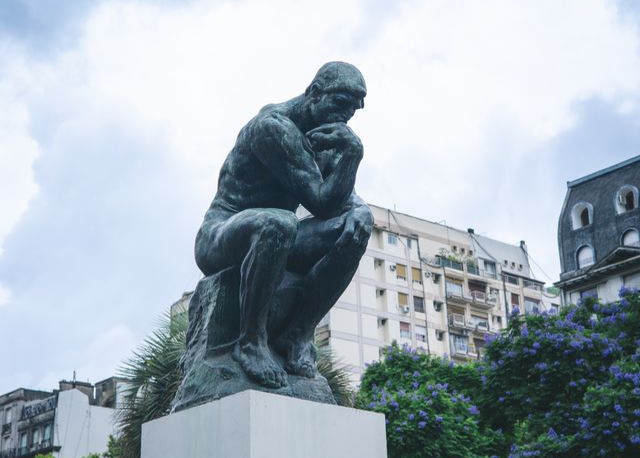
Blaise Pascal: Let us endeavour to think clearly, for that is the basis of all morality.
The conventional context of ‘sustainability’ is that of carbon emissions, global warming, climate change … et cetera. This post argues that another crucial factor contributes even more to make human life truly sustainable, truly worth living.
Consider this commonplace observation: All human beings seekfulfilment. A child, a parent, a youngster, an adult, an elderly person – anywhere in the world, in any culture, in any country – seeks fulfilment. A child finds fulfilment in a toy, a parent in child’s well-being, an adult in money … and so on.
It is impossible to conceive of a human act not aimed at the fulfilment of a need or a desire.
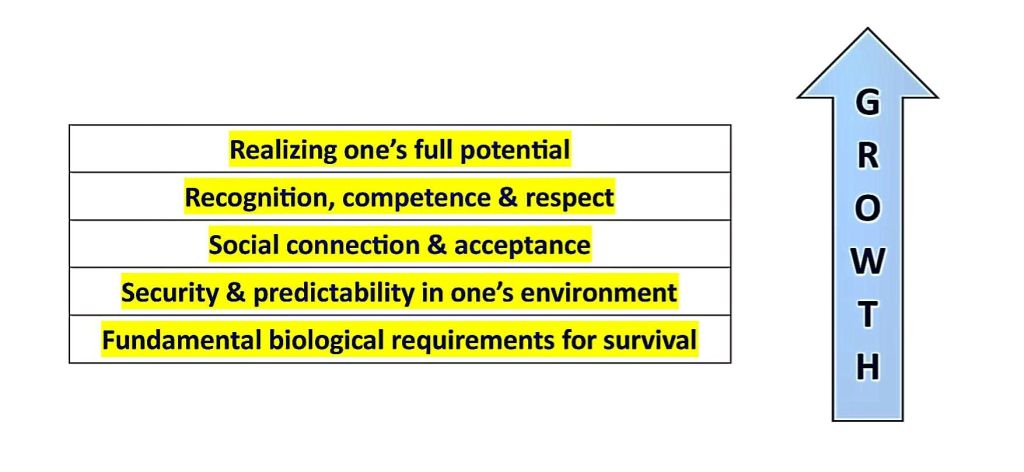
The need for fulfilment is depicted very well in the form of the well-known Maslow’s hierarchy of needs, which is in fact better described as hierarchy of fulfilment. The hierarchy (see below), goes from basic biological needs to self-actualization.
A rise from a lower level of the hierarchy to a higher level represents individual growth. This is arguably the true, psychological meaning of individual growth.
A few points to note:
Lack of fulfilment at any level creates psychological issues. Frustration can ensue; if frustration persists, impatience and/or bad judgement can make matters worse.
Beyond a threshold, the fulfilment of the need at any one level reaches a point of diminishing returns. Potential for further individual growth is then found at the next higher level of the hierarchy. Einstein said: You cannot solve a problem with the same mind that created it.
An individual needs to assess his growth along the hierarchy. Blindly emulating another person – even a ‘hero’! – can seriously disorient the individual, especially since the chosen ‘hero’ may be seriously but secretly disoriented himself!
A strictly ‘materialistic’ view of life assumes that the hierarchy and all the above points are irrelevant; and that one can pass one’s whole life prancing about at the lowest two levels of the hierarchy.
In healthy community life, an individual finds role models and mentors to guide him along the path of fulfilment. An ‘atomized individual’, cut off from community, lacks this possibility.
In the age of 24×7 distraction with information of every possible kind, it has become extremely difficult for an individual to assess his position and growth along the hierarchy of fulfilment.
Role of natural intelligence (NI)
A decade or so ago, the phrase ‘artificial intelligence’ (‘AI’) took hold of people’s imagination. Silicon valley entrepreneurs have played a big role in the propaganda behind ‘AI’. No doubt they hope to profit hugely from the major economic boom that the technology is supposed to set off, any day now.
Natural intelligence (NI) has always been an integral part of being human. Over tens of millennia, NI has brought to mankind not only sustainability but also progress. The biological name of our species is Homo Sapiens, of which the second word means ‘intelligent’.
But natural intelligence is a double-edged gift. It has a tendency to backfire, resulting in swindles, crime, conflicts, massacres … and more. In other words, NI is vulnerable, fallible, prone to pressures of mind and to breakdown.
Lack of fulfilment leads to frustration and, very often, doubling down on a losing strategy. This leads to negativity, nihilism, a desire to ‘end it all’, criminal neglect of the common good … and so on. Clearly, such states of mind are in opposition to sustainability.
Old need not be gold
Some assertions are said to be ‘religious’, because (a) they originated thousands of years ago, and (b) over the period, they have provided wealth, prestige and power to millions of so-called ‘elites’.
To focus on sustainability, however, logic dictates that these ancient assertions – ‘religious’ or otherwise – must be judged only by the test of whether they promote and support sustainable human life on Planet Earth.
By this simple test, ‘religious’ concepts such as ‘end of times’, ‘armageddon’, ‘apocalypse’ … et cetera … must be judged to be extremely negative, evoking an ‘end it all’ mindset.
In the Asian view of life, a central concept is that of DharmaChakra, meaning that life follows a never-ending cycle of decline and rise, death and new life. Therefore phrases such as those cited make no sense whatsoever.
Role of happiness
Observation: Happy communities sustain themselves. The desire to sustain one’s family and culture is inseparable from a fulfilled life. A saying one sometimes comes across in Gujarat can be rendered thus in English: If there is paradise on earth, it is only in a happy family.
So then why do we see falling birth rates in so-called ‘advanced’ societies? Strangely, economists are worried about falling birth rates, but not about what makes unhappy young people turn away from the inborn desire to raise happy families! A societal, cultural problem cannot be solve by tweaking taxes or interest rates! Or perhaps that aspect of natural human behaviour is not taught in academia! 😉
The basic, root-cause dangers to sustainability are: wrong thinking; no love of children; no happy family life; indeed, no true love of life; no true fulfilment. The built-up frustration, dissatisfaction and nihilism leads to unending greed and over-consumption.
It is quite likely that a highly urbanized, indebted and flagrantly materialistic lifestyle – dependent on very long supply chains – will not sustain itself over the longer term. Economic fragility will show up as a major crash. Rural communities will likely adapt better than highly urbanized ones. With ingenuity and cooperative effort, appropriate technologies and adaptations will be found.
Many of today’s global ‘champions of sustainability’ flaunt highly unsustainable lifestyles. Recommending a policy for others requires an empathetic understanding of others’ lives. That a bunch of arrogant multi-millionaires flying around in private jets can have an empathetic understanding of others is beyond belief!
For centuries, the Bishnoi community of western Rajasthan have been following zero-waste, sustainable lifestyles. The name of the community derives from twenty nine rules which they follow strictly, relating to water, vegetation, other forms of life … and so on. The Bishnois are true champions of sustainability, true heroes.
What needs to be sustained is the priceless human potential to find true fulfilment, happiness and equilibrium with nature, for the current and all future generations. What need NOT be sustained, or even tolerated, are political games, propaganda, virtue signalling, chasing fame and chasing fortune — even if all that is claimed to be done for the ever-so-noble cause of ‘sustainability’!😉
A colourful butterfly in a garden is a better ambassador for sustainability than, for example, John Kerry.
[Editorial note: Consider this ‘eternal mathematical truth’: (a+b)×c = a×c + b×c. A mathematician, centuries ago, must have divined and articulated this truth. Surely however, in commerce, this truth held even in earlier epochs. Suppose you had two bags of fruit, with a given unit price. Then you got the same total price (a) by adding the two weights and pricing the total, or (b) by weighing and pricing the bags separately and then adding the two prices. Surely that bit of commercial truth is also eternal, regardless of what mathematicians say!
Eternal truths are timeless. They held in ages past, hold today and will continue to hold in whatever future we may be heading into. Today Jayram Daya has selected for discussion one such eternal truth; not a mathematical truth, but a societal one, from Srimad Bhagwatam.
Read, reflect and enjoy!]
वित्तमेव कलौ नृणां जन्माचारगुणोदय: । धर्मन्यायव्यवस्थायां कारणं बलमेव हि ॥ २ ॥
In Kali-Yuga, wealth alone is considered the sign of a man’s good birth, proper behaviour and fine qualities. Law and justice are applied only on the basis of power.
Shrimad Bhagwatam (verse 12.2.2).
The wisdom of this ancient verse reads less like scripture and more like a headline in 2026. The verse says that in Kali-Yuga, merit is replaced by the sheer weight of a wallet, and justice becomes a commodity rather than a right.
When we examine the current global landscape, especially through figures like Donald Trump, these truths are not remote or subtle; they are glaring and unmistakable; they have become the defining characteristics of our era.
Wealth as the new definition of virtue
The verse states that wealth alone will be considered the sign of a man’s good birth, proper behaviour, and fine qualities.
Modern society views net worth as a sign of competence.
Consider Trump. His entire political identity has been built on his branding as a ‘billionaire dealmaker’. For millions, his wealth served not merely as an asset but as a moral credential, pre-authorizing his leadership irrespective of his dubious ethical record. The Bhagavatam states clearly that external wealth is mistaken for personal qualities.
Global ‘success’ culture
We see this everywhere, from the glorifying of ‘grind culture’, to influencers who hawk luxury and excess dressed up as insight and wisdom. The elevation of wealth as the sole criterion of ‘good fortune’ results in devaluation of character, and redirection of societal ambition almost exclusively towards wealth acquisition and ostentation.
Power as the arbiter of law
The second half of the verse is even more striking: Law and justice is applied only based on one’s power.
In 2025 and 2026, we have watched as the legal systems of the world’s most powerful nations struggle to hold the elite accountable. Whether it is through endless litigation, the ‘transactional’ appointment of judges, or the use of political office to bypass indictments, the message is clear: Justice is no longer blind; it now measures worth by the size of one’s balance sheet.
A ‘might-makes-right’ world
International relations have returned to a pure transactional approach. The use of power, financial and military, is now used to unilaterally reshape borders and trade agreements, to the exclusion of any international dharma. When a figure uses his position to ‘rule the world’ through sheer force of personality and purse, the rest of the world often feels silenced, unable to challenge the brute strength, बलम, on display.
Reclaiming the servant
Srimad Bhagwatam does not just diagnose the disease; it reminds us of the cure. The danger isn’t money itself, but its elevation to the status of god. The more money becomes the ‘ruthless master’, the more humans become ‘asses’, in working tirelessly for superficial and meagre rewards.
One way to challenge the Kali-Yuga mindset is to restore the integrity of money. It requires a return to substance over status and dignity over dominance.
Heed the warning
The verse in question does not condemn modernity; rather, it explains modernity. In 2026, the verse reads like a prescient, sober diagnosis of a world of inverted values. Donald Trump’s position of power illustrates how easily wealth can be covered up as virtue and power as righteousness. That is the true meaning of Kali-yoga.
The challenge, then, is not political but civil. Restoring justice depends on reaffirming that money is a means, not a badge of legitimacy, and that power must operate within the law rather than stand above it. Without this correction, the eternal truth continues to unfold, not as prophecy, but as lived reality.
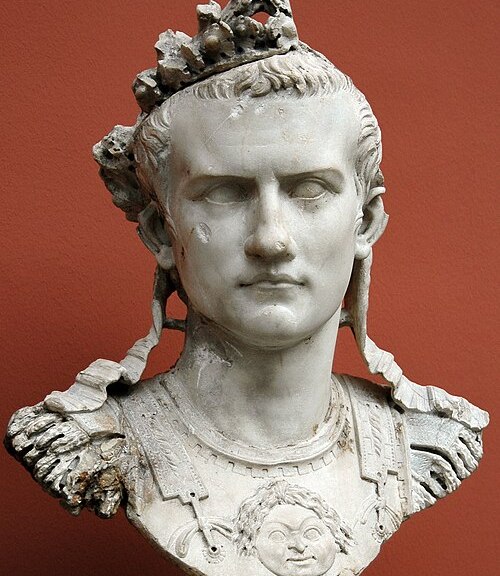
[Image: Bust of Emperor Caligula of Rome; photograph by Sergey Sosnovskiy; courtesy: wikimedia]
Today money has moved from being a means of sustenance to a measure of success, power and self-worth. Never before had humanity been so intensely focused on increasing wealth, and that with such almost obscene haste. It is no secret that speed has become a defining obsession in the world of speculative markets and digital assets, from side-hustles to instant-profit scams. Inevitably, because of such self-defeating haste, money’s true value has been distorted and destroyed.
This is an attempt to summarize, using a broad sweep, global events over the past few centuries. Viewpoints may differ, of course, but it is hoped that the summary does capture the essentials.
Should I try to be a moral person? A nice guy? A law-abiding citizen? Or would that turn me into a loser? An impractical dreamer?
How do I become a winner? A realist?
Can I become a cunning operator in a philanthropist’s garb? Is that option available to me? Or only to some billionaires? Is greed really good – as they say on Wall Street?
Questions, questions … and more questions! But – alas! – no clear answers!
In the hope that a discussion around such questions would be of interest to everyone, we attempt here an exploration of some basic issues.