Finance, happiness and their interplay are important topics. The world is highly financialized, and filled with unhappiness. Unhappiness often erupts in violent crime and also larger conflicts. A fresh look at these two is not out of place.
Information age, AI, virtual reality, global hegemony, tariffs, space war, cyber war — many such heavy words are being bandied about 24×7. What is one to make of it all? How does one chart one’s path through the bewildering recent outpouring of geopolitics and technology?
This post argues that the answer is ‘as old as the hills‘. A person’s inner voice, nurtured and clarified through persistent individual effort, is still the most reliable guide — just as it has been over millennia.
Soon after the previous post was published on this blog, we came across the definition of a so-called Social Well-being Index(SWI), introduced by a group within Russia. Briefly, the SWI index is based on these criteria: lifeexpectancy, infantmortalityrate, homiciderate, total fertility, income inequality, educationlevel.
This post is an invitation to readers to consider new ways to assess how wisely a society spends the resources available to it. The post is not a ‘scholarly research paper’, as that phrase is understood, but merely an essay. [Note 1]
Blaise Pascal: Let us endeavour to think clearly, for that is the basis of all morality.
The conventional context of ‘sustainability’ is that of carbon emissions, global warming, climate change … et cetera. This post argues that another crucial factor contributes even more to make human life truly sustainable, truly worth living.
Consider this commonplace observation: All human beings seekfulfilment. A child, a parent, a youngster, an adult, an elderly person – anywhere in the world, in any culture, in any country – seeks fulfilment. A child finds fulfilment in a toy, a parent in child’s well-being, an adult in money … and so on.
It is impossible to conceive of a human act not aimed at the fulfilment of a need or a desire.
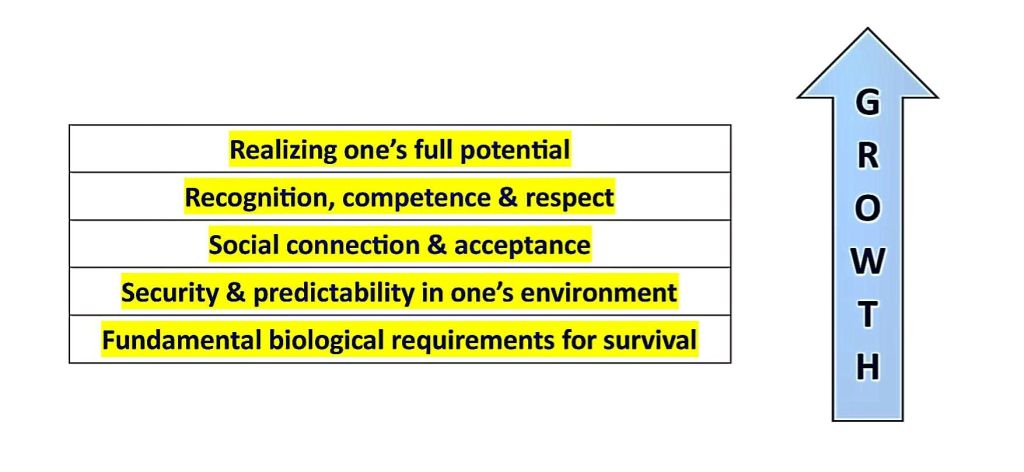
The need for fulfilment is depicted very well in the form of the well-known Maslow’s hierarchy of needs, which is in fact better described as hierarchy of fulfilment. The hierarchy (see below), goes from basic biological needs to self-actualization.
A rise from a lower level of the hierarchy to a higher level represents individual growth. This is arguably the true, psychological meaning of individual growth.
A few points to note:
Lack of fulfilment at any level creates psychological issues. Frustration can ensue; if frustration persists, impatience and/or bad judgement can make matters worse.
Beyond a threshold, the fulfilment of the need at any one level reaches a point of diminishing returns. Potential for further individual growth is then found at the next higher level of the hierarchy. Einstein said: You cannot solve a problem with the same mind that created it.
An individual needs to assess his growth along the hierarchy. Blindly emulating another person – even a ‘hero’! – can seriously disorient the individual, especially since the chosen ‘hero’ may be seriously but secretly disoriented himself!
A strictly ‘materialistic’ view of life assumes that the hierarchy and all the above points are irrelevant; and that one can pass one’s whole life prancing about at the lowest two levels of the hierarchy.
In healthy community life, an individual finds role models and mentors to guide him along the path of fulfilment. An ‘atomized individual’, cut off from community, lacks this possibility.
In the age of 24×7 distraction with information of every possible kind, it has become extremely difficult for an individual to assess his position and growth along the hierarchy of fulfilment.
Role of natural intelligence (NI)
A decade or so ago, the phrase ‘artificial intelligence’ (‘AI’) took hold of people’s imagination. Silicon valley entrepreneurs have played a big role in the propaganda behind ‘AI’. No doubt they hope to profit hugely from the major economic boom that the technology is supposed to set off, any day now.
Natural intelligence (NI) has always been an integral part of being human. Over tens of millennia, NI has brought to mankind not only sustainability but also progress. The biological name of our species is Homo Sapiens, of which the second word means ‘intelligent’.
But natural intelligence is a double-edged gift. It has a tendency to backfire, resulting in swindles, crime, conflicts, massacres … and more. In other words, NI is vulnerable, fallible, prone to pressures of mind and to breakdown.
Lack of fulfilment leads to frustration and, very often, doubling down on a losing strategy. This leads to negativity, nihilism, a desire to ‘end it all’, criminal neglect of the common good … and so on. Clearly, such states of mind are in opposition to sustainability.
Old need not be gold
Some assertions are said to be ‘religious’, because (a) they originated thousands of years ago, and (b) over the period, they have provided wealth, prestige and power to millions of so-called ‘elites’.
To focus on sustainability, however, logic dictates that these ancient assertions – ‘religious’ or otherwise – must be judged only by the test of whether they promote and support sustainable human life on Planet Earth.
By this simple test, ‘religious’ concepts such as ‘end of times’, ‘armageddon’, ‘apocalypse’ … et cetera … must be judged to be extremely negative, evoking an ‘end it all’ mindset.
In the Asian view of life, a central concept is that of DharmaChakra, meaning that life follows a never-ending cycle of decline and rise, death and new life. Therefore phrases such as those cited make no sense whatsoever.
Role of happiness
Observation: Happy communities sustain themselves. The desire to sustain one’s family and culture is inseparable from a fulfilled life. A saying one sometimes comes across in Gujarat can be rendered thus in English: If there is paradise on earth, it is only in a happy family.
So then why do we see falling birth rates in so-called ‘advanced’ societies? Strangely, economists are worried about falling birth rates, but not about what makes unhappy young people turn away from the inborn desire to raise happy families! A societal, cultural problem cannot be solve by tweaking taxes or interest rates! Or perhaps that aspect of natural human behaviour is not taught in academia! 😉
The basic, root-cause dangers to sustainability are: wrong thinking; no love of children; no happy family life; indeed, no true love of life; no true fulfilment. The built-up frustration, dissatisfaction and nihilism leads to unending greed and over-consumption.
It is quite likely that a highly urbanized, indebted and flagrantly materialistic lifestyle – dependent on very long supply chains – will not sustain itself over the longer term. Economic fragility will show up as a major crash. Rural communities will likely adapt better than highly urbanized ones. With ingenuity and cooperative effort, appropriate technologies and adaptations will be found.
Many of today’s global ‘champions of sustainability’ flaunt highly unsustainable lifestyles. Recommending a policy for others requires an empathetic understanding of others’ lives. That a bunch of arrogant multi-millionaires flying around in private jets can have an empathetic understanding of others is beyond belief!
For centuries, the Bishnoi community of western Rajasthan have been following zero-waste, sustainable lifestyles. The name of the community derives from twenty nine rules which they follow strictly, relating to water, vegetation, other forms of life … and so on. The Bishnois are true champions of sustainability, true heroes.
What needs to be sustained is the priceless human potential to find true fulfilment, happiness and equilibrium with nature, for the current and all future generations. What need NOT be sustained, or even tolerated, are political games, propaganda, virtue signalling, chasing fame and chasing fortune — even if all that is claimed to be done for the ever-so-noble cause of ‘sustainability’!😉
A colourful butterfly in a garden is a better ambassador for sustainability than, for example, John Kerry.
Moments that touch my senses create memories that shape how I see myself. I had this experience rather intensely while watching the recent Olympics, where my role as an observer taught me a lot about human emotions.
I noticed how my feelings would change based on whether I was cheering for the winners or feeling sorry for the losers. When someone I liked won, I felt pure joy, with no thought of those who lost. But when my favourite person lost, I felt disappointment and even resentment towards the winner.
This made me realize how our emotions are tied to personal preferences and connections. It also showed me that by thinking about and understanding our feelings, we can better manage them, seeing the human side in all our experiences.
Exploring ‘Me and Myself’ also helped me understand why people seek happiness and excitement. Here are some of my observations:
Social bonding: People love to share joy and excitement with others.
Pleasure and excitement: Competitions generate excitement and a sense of reward for spectators.
Emotional investment: Defined as the degree to which we get deeply involved emotionally, either happy or disappointed, depending on the outcome.
Engaging the senses: Live events stimulate our senses, making the experience more real.
Escape from routine: Forays which provide momentary breaks from the routine and the stress of daily life.
Belonging: Fans feel connected to a group or team, creating a sense of belonging.
Suspense and anticipation: We stay engaged because we cannot predict the outcome.
Shared joy or sorrow: Winning or losing brings people together, strengthening bonds.
Interestingly, people sometimes even prepare for losing, for the following reasons:
Emotional strength: Fans learn to cope with disappointment.
Hope: Even when the outlook is gloomy, fans remain hopeful.
Loyalty: True fans stick with their team, win or lose.
All these elements combine to make live sports events a part of our culture and entertainment.
What is happiness?
Everyday experience suggests that happiness is a state of mind born from sensory moments. It can be brief and powerful, but it is often tied to the moment. As I narrated above, this became clear to me as I watched the Olympics. My emotions were a reflection of my connections, my likes, and my sense of patriotism.
This got me thinking about why we are so happy when things are our way, and why happiness often does not involve any compassion for others. I realized that our emotions are tied to our desires. When our hopes are fulfilled, we feel joy, but when they are not, disappointment can cloud our ability to appreciate others’ success.
I learned that true happiness might not come from winning, but from appreciating the effort and the spirit behind both victory and defeat. Happiness, in its purest form, is about understanding and accepting both victory and defeat.
Winning and losing
Through my study of ‘Me and Myself’, which reflects the connection between my inner self and outer persona, I noticed how emotions are expressed physically and emotionally in moments of victory and defeat.
When someone wins, they often run towards their loved ones and hug them tight, joy evident in their laughter and tears. But when someone loses, the pain can be overwhelming, leading to tears, frustration, and a desire to be alone.
These experiences illustrate that all five senses — sight, sound, touch, taste and smell — play a role in expressing happiness or sadness. The body also responds in other ways, relieving stress through bodily gestures that express our feelings.
This understanding highlights the deep connection between our bodies and minds in these intense moments. It also raises the question of whether we can discipline our senses to manage these expressions better.
What does ‘Me and Myself’ mean?
‘Me and Myself’ represents the connection between my inner self and outer persona, embracing my uniqueness and solitude. Spiritually, I see ‘Me’ as consciousness, and ‘Myself’ as the one who interacts with the five senses.
The mind, as ‘the sense within’, processes and integrates information from the five senses, enabling thought and consciousness. Happiness is therefore a state of mind born from sensory moments, integrating information from the five senses and the mind — ‘the sense within’ — processing and interpreting sensory data.
Ananda
Further reflection activated a realization that mastering the senses, as emphasized in ancient Indian tradition, can lead to a stable mind. Sat-chit-ananda is a Sanskrit term that describes the true nature of reality as existence, consciousness, and bliss. It refers to the ultimate, unchanging reality known as Brahman. Sat means existence; chit means consciousness, and ananda means bliss, the absence of suffering.
Unlike momentary happiness tied to external objects, ananda is a profound, inner bliss, which is not dependent on the material world, but is a spiritual joy experienced deep within.
Distress can be of different kinds. It may arise due to material needs not being fulfilled, or from situations beyond one’s control, such as acts of nature. Distress may be due to a man-made situation, like a conflict or an accident. Or it may arise from emotional stress, such as fear of failure, loss of a near one, illness, heart-break or a negative emotion.
Several centuries after the decline of the Romans, the major European naval powers had laid the groundwork for a culture of colonization and exploitation. By that time, the Anglo-Saxons had established themselves in England. Their belief in ‘God, Gold, and Glory’ spurred British colonization in the New World, altering history forever. The other European naval powers who likewise set out to colonize and exploit were Spain, Portugal, France and the Dutch.
Last week a discussion took place within our WhatsApp group on the subject of wellbeing, quite broadly defined. Members shared their views, based on their own knowledge and experience. Overall, the members’ views, when arranged together, took the form of a panel discussion. Needless to say, in a discussion among friends, nobody had a personal axe to grind. Views were shared in the hope that a thoughtful reader may find something useful in them.
It is in that spirit that are we presenting the views here.
Today we present contributions from three of our members, Suman Rao, R. Srinivasan and Naresh Jotwani. The common aim of these pieces is to bring out the fascinating relationship between the truths we seek within, and the lives we live in the world outside. We believe that sincere, first person accounts of good friends are at least as valuable as scriptures.