by Naresh Jotwani
Blaise Pascal: Let us endeavour to think clearly, for that is the basis of all morality.
The conventional context of ‘sustainability’ is that of carbon emissions, global warming, climate change … et cetera. This post argues that another crucial factor contributes even more to make human life truly sustainable, truly worth living.
Consider this commonplace observation: All human beings seek fulfilment. A child, a parent, a youngster, an adult, an elderly person – anywhere in the world, in any culture, in any country – seeks fulfilment. A child finds fulfilment in a toy, a parent in child’s well-being, an adult in money … and so on.
It is impossible to conceive of a human act not aimed at the fulfilment of a need or a desire.
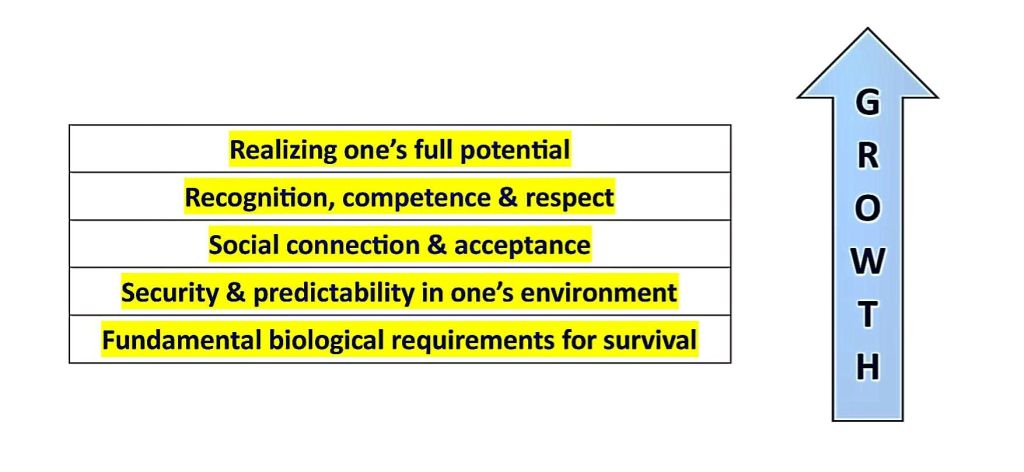
The need for fulfilment is depicted very well in the form of the well-known Maslow’s hierarchy of needs, which is in fact better described as hierarchy of fulfilment. The hierarchy (see below), goes from basic biological needs to self-actualization.
A rise from a lower level of the hierarchy to a higher level represents individual growth. This is arguably the true, psychological meaning of individual growth.
A few points to note:
- Lack of fulfilment at any level creates psychological issues. Frustration can ensue; if frustration persists, impatience and/or bad judgement can make matters worse.
- Beyond a threshold, the fulfilment of the need at any one level reaches a point of diminishing returns. Potential for further individual growth is then found at the next higher level of the hierarchy. Einstein said: You cannot solve a problem with the same mind that created it.
- An individual needs to assess his growth along the hierarchy. Blindly emulating another person – even a ‘hero’! – can seriously disorient the individual, especially since the chosen ‘hero’ may be seriously but secretly disoriented himself!
- A strictly ‘materialistic’ view of life assumes that the hierarchy and all the above points are irrelevant; and that one can pass one’s whole life prancing about at the lowest two levels of the hierarchy.
- In healthy community life, an individual finds role models and mentors to guide him along the path of fulfilment. An ‘atomized individual’, cut off from community, lacks this possibility.
- In the age of 24×7 distraction with information of every possible kind, it has become extremely difficult for an individual to assess his position and growth along the hierarchy of fulfilment.
Role of natural intelligence (NI)
A decade or so ago, the phrase ‘artificial intelligence’ (‘AI’) took hold of people’s imagination. Silicon valley entrepreneurs have played a big role in the propaganda behind ‘AI’. No doubt they hope to profit hugely from the major economic boom that the technology is supposed to set off, any day now.
Natural intelligence (NI) has always been an integral part of being human. Over tens of millennia, NI has brought to mankind not only sustainability but also progress. The biological name of our species is Homo Sapiens, of which the second word means ‘intelligent’.
But natural intelligence is a double-edged gift. It has a tendency to backfire, resulting in swindles, crime, conflicts, massacres … and more. In other words, NI is vulnerable, fallible, prone to pressures of mind and to breakdown.
Lack of fulfilment leads to frustration and, very often, doubling down on a losing strategy. This leads to negativity, nihilism, a desire to ‘end it all’, criminal neglect of the common good … and so on. Clearly, such states of mind are in opposition to sustainability.
Old need not be gold
Some assertions are said to be ‘religious’, because (a) they originated thousands of years ago, and (b) over the period, they have provided wealth, prestige and power to millions of so-called ‘elites’.
To focus on sustainability, however, logic dictates that these ancient assertions – ‘religious’ or otherwise – must be judged only by the test of whether they promote and support sustainable human life on Planet Earth.
By this simple test, ‘religious’ concepts such as ‘end of times’, ‘armageddon’, ‘apocalypse’ … et cetera … must be judged to be extremely negative, evoking an ‘end it all’ mindset.
In the Asian view of life, a central concept is that of Dharma Chakra, meaning that life follows a never-ending cycle of decline and rise, death and new life. Therefore phrases such as those cited make no sense whatsoever.
Role of happiness
Observation: Happy communities sustain themselves. The desire to sustain one’s family and culture is inseparable from a fulfilled life. A saying one sometimes comes across in Gujarat can be rendered thus in English: If there is paradise on earth, it is only in a happy family.
So then why do we see falling birth rates in so-called ‘advanced’ societies? Strangely, economists are worried about falling birth rates, but not about what makes unhappy young people turn away from the inborn desire to raise happy families! A societal, cultural problem cannot be solve by tweaking taxes or interest rates! Or perhaps that aspect of natural human behaviour is not taught in academia! 😉
The basic, root-cause dangers to sustainability are: wrong thinking; no love of children; no happy family life; indeed, no true love of life; no true fulfilment. The built-up frustration, dissatisfaction and nihilism leads to unending greed and over-consumption.
It is quite likely that a highly urbanized, indebted and flagrantly materialistic lifestyle – dependent on very long supply chains – will not sustain itself over the longer term. Economic fragility will show up as a major crash. Rural communities will likely adapt better than highly urbanized ones. With ingenuity and cooperative effort, appropriate technologies and adaptations will be found.
Many of today’s global ‘champions of sustainability’ flaunt highly unsustainable lifestyles. Recommending a policy for others requires an empathetic understanding of others’ lives. That a bunch of arrogant multi-millionaires flying around in private jets can have an empathetic understanding of others is beyond belief!
For centuries, the Bishnoi community of western Rajasthan have been following zero-waste, sustainable lifestyles. The name of the community derives from twenty nine rules which they follow strictly, relating to water, vegetation, other forms of life … and so on. The Bishnois are true champions of sustainability, true heroes.
What needs to be sustained is the priceless human potential to find true fulfilment, happiness and equilibrium with nature, for the current and all future generations. What need NOT be sustained, or even tolerated, are political games, propaganda, virtue signalling, chasing fame and chasing fortune — even if all that is claimed to be done for the ever-so-noble cause of ‘sustainability’!😉
A colourful butterfly in a garden is a better ambassador for sustainability than, for example, John Kerry.

