
by Naresh Jotwani
Finance, happiness and their interplay are important topics. The world is highly financialized, and filled with unhappiness. Unhappiness often erupts in violent crime and also larger conflicts. A fresh look at these two is not out of place.
On the relationship between finance and happiness, there are many opinions. A short sample:
- Finance IS happiness.
- Finance is the main ingredient of happiness.
- Finance is the path to happiness.
- The two have nothing to do with each other.
The two words are not synonyms, since one can easily find real-life examples such as (1) a financially deprived person who experiences happiness, and (2) a financially well-endowed person who experiences unhappiness. Of course neither a person’s financial status nor his happiness is permanent. The point is only that these two do not always coincide.
What is the relationship between these two?
One can list a few different versions of happiness:
- Individual happiness grounded in understanding and acceptance.
- Family happiness, based on love, security, care, warmth, comfort, the nurture of children; ‘family’ here includes close friends.
- Individual happiness linked to achievement in any endeavour. Examples are not only superstars such as Federer, but any youngster topping a competitive exam or winning a medal. Individual happiness grows many-fold if it is shared with a team, family or friends.
One first experiences happiness in a family, as a child. In that experience, the mother’s role is central and indispensable. This was true in stone age, and it is true today. There is nothing new under the sun.

Finance is a man-made yardstick used as: (a) a measure of achievement, (b) the hope of future happiness, and/or (c) an instrument of individual will. This yardstick is created in the form of legal tokens such as stone tablets or computer data.
Happiness is a real state of mind which a person longs to attain. The effort to turn unhappiness to happiness is in human DNA. Finance, the set of tokens, may or may not result in happiness, but surely that would be an objective.
Does the happiness in making, say, USD 1,000,000/- rank lower or higher than that in playing music, or breaking an athletics record, or teaching a toddler to draw?
That is a pointless question. Persons are happy for different reasons, but their states of mind cannot be compared. Finance can bring about that state of mind, but so can countless other causes. No instrument can assess even a single person’s state of mind; comparing the states of mind of two or more persons is out of the question.
Anything is cherished in life only for its potential to fulfill the longing for happiness. Finance represents ‘hope for happiness some day’, but that happiness may not exist ‘here and now’. A person’s financial score may rise like a rocket – to millions, billions, gazillions … whatever. But if his state of mind is not wholesome, happiness may be missing.
Having financial tokens in large numbers gives a person power over others – specifically, over those who are in need of tokens for their own happiness. This power can easily turn toxic.
The late Henry Kissinger once said: Power is the ultimate aphrodisiac. Of course his still extant fan club gushes over his ‘smartness’. But that statement can actually be re-interpreted to reveal this: Dissatisfaction in sexual matters creates the hunger for power. Quite possibly, every power-hungry SOB may have precisely this underlying problem. A happily married person caring for his kids does not need aphrodisiacs.
In any society, there would be instances of an individual turning his back on family happiness and focussing exclusively and feverishly on finance. That would have implications for the person, his family, friends … et cetera … but not for the whole society.
What happens if this attitude spreads to the whole society? Only a single societal role model then remains intact: Gathering ever more financial tokens. With no other value or thought in place, all means of financial gain become acceptable. Then the society worships only one ‘god’ – ‘the cruel god of finance’ – who demands the sacrifice of everything else, including community life and family happiness.
In such a situation, the central role of the mother gets neglected and reduced to a transactional level, fulfilling merely a physical need. A devoted mother is usually weak in playing transactional games. If the husband is a ‘smart financial operator’, he may easily take advantage of that weakness, at the expense of family life, and believe that he did something ‘smart’.
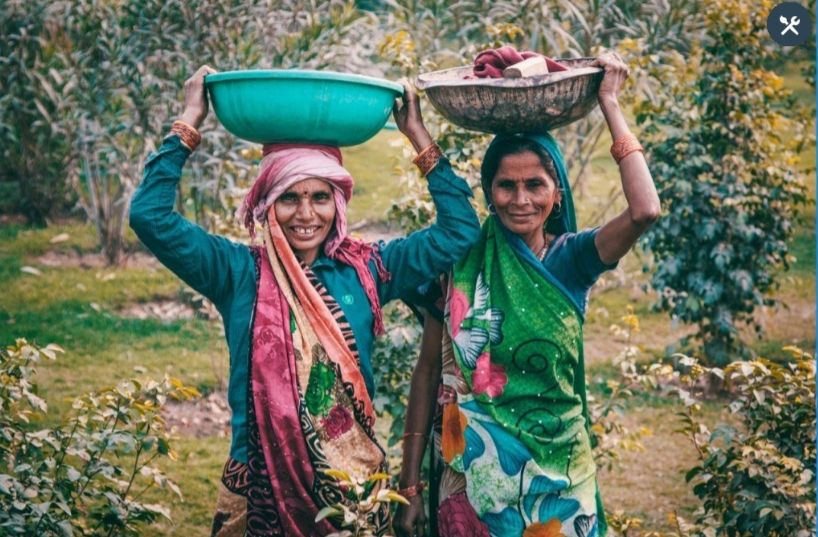
The author has witnessed a healthier attitude amongst the local rural communities. Every community is devoted to their ‘mother deity’ – माता in Hindi (see Note 1). People have a healthy attitude towards finance, but they are certainly not ‘hung up’ or paranoid about it. The richest guy in the community will be beaten up if he shows disrespect to the ‘mother deity’ — not that anybody would be that stupid. The central importance of motherhood is not forgotten.
On the whole, possibly as much as 90% of the population of India lives by the customs and norms of their communities. They are the farmers, traders, soldiers, potters, cattle owners, mechanics, masons, carpenters, drivers … and so on. They make up the physically productive segment of the economy, as opposed to the government, managerial, legal, financial and IT segments.
On the whole, these 90% of the people are in lower income groups. Not being English educated, they do not participate in the endless yakety-yak of seminars and TV studios. However, at least by one measure — coping with life without whining and neuroses — they do much better than the ‘western elites’ and their copycats.
Relevance: Today the ‘westernized elite’ in India have Total Fertility Rate (TFR) of less than 1.5, while the rest have TFR of 2.1, with regional variations. This pattern is likely to continue over at least the next couple of decades. The former’s share of population will therefore decline by about 1.5%, and so the ‘non-westernized’ segment will increase in influence. In the interests of harmony, it makes sense to understand and respect the culture of that large, resilient and productive segment of society.
In the US, the phrase ‘land of milk and honey’ once reflected a state of plentiful natural resources, a land of happiness. That state cannot preserve itself in an overly financialized society. Once motherhood is looked down upon, true love is expunged from life — and the society scripts its own decline.
‘The land of milk and honey’ turns into ‘the land of bets, debts, and derivatives’. Nurture, love, warmth and care are thrown overboard – and replaced by finance, power, hubris and sense pleasures (see Note 2).
The present-day ‘kings of finance’ are no more than pirates and marauders. They constantly seek new lands to pillage, to loot the people of their own lands and of the Global South.
Note 1: A few names of the ‘mother deities’ of different local communities are Amba, Umiya, Chamunda, Khodiyar, Khodal and Sikotar. ‘Jai Mata Di‘ — that is, ‘Hail to the Mother‘ — is a common greeting. No outsider is needed here to spread the ‘modern’ message of ‘woman empowerment’.
Note 2: An NRI cousin visiting India once drew the author’s attention to a migrant labourer family working by the roadside. He remarked casually that the kids were in an unfortunate condition (or words to that effect). The author replied that the family, although poor, was taking good care of the children. Would a millionaire’s kids be better off if they lacked family love and their care was provided by hired help? For whatever reason, the cousin did not reply. To be fair, his own family in the US lacks neither love nor finance.

