The following lines from Shakespeare’s Hamlet constitute the most famous soliloquy in English literature:
To be, or not to be, that is the question: Whether ’tis nobler in the mind to suffer The slings and arrows of outrageous fortune, Or to take arms against a sea of troubles And by opposing end them.
Based on an earlier post on this blog (here), Keshav Vaze raised a very interesting question. His question prompted me to look for a rational answer, in the sense defined below. Some prior knowledge of Spinoza and of Vedant helped in formulating the answer, which I hope the reader will find to be of interest.
Keshav:
As an exercise in logic, can we arrive at Santana Dharma – that is, eternal law – through a point of view which is not anthropocentric?
Consider this excerpt from an earlier post:
A broadly accepted list of virtues in our tradition is this: generosity, morality, renunciation, wisdom, perseverance, forbearance, truthfulness, determination, love and equanimity.
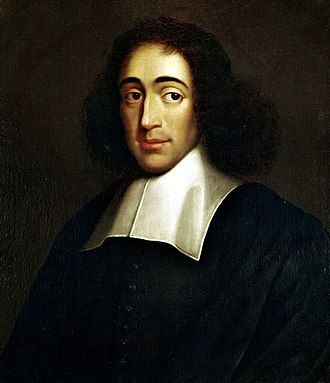
According to Spinoza, these concepts of ethics are human-centric, but there is no basis for believing that God — or Nature or some law of Physics — created the universe with humans in mind. In Spinoza’s philosophy, humans are not considered inherently more important than any other part of nature.
Baruch Spinoza (1632-1677)
According to Spinoza, true ethical behaviour arises from understanding our place within this unified system and aligning our actions with the natural order. In this way, we can talk rationally about ecology, environmental protection, bio-diversity … et cetera.
A young physicist on vacation, trekking through a dense jungle, had to spend a night at a hamlet with a tribe of friendly jungle-dwellers. In the morning, fully rested, he saw tribal elders praying in front a few small piles of dust of different colours. The dust was yellow in one pile, orange in another, red in yet another … and so on. The coloured piles were neatly arranged in a geometric pattern.
[Our previous post (here) contained only the introductory part of Suman’s article on Karma. This is the full article.]
Karma is the all-encompassing concept of action and reaction in a continuous chain in time and space. It is inclusive of causality as conceived in Science. It includes the effects of grief, hurt and wounds caused to ‘another’ or ‘others’. That is nothing but insecurity playing upon the ego which is nothing but false sense of separation. Until the ego with its limited contents of consciousness drops its limited identity and becomes one with all, through repeated experiences of samadhi, this sense of separation continues and actions are of a mixed nature.
The co-editors of this blog, Srinivasan and Naresh, have also been running a WhatsApp group named seeker-of-root-causes. Occasionally, a question or a statement is posed to group members, to which members are invited to respond with their own views.
The practical context and significance of today’s topic will be established by this first-person, true life account submitted by Srinivasan:
My own experiences have taught me the enormous scope of karma in practical life, and totally ingrained the concept in my psyche. I will cite just one specific instance here.