
by Naresh Jotwani
In mid-1939, Gandhiji addressed the following letter to Adolf Hitler. The British did not allow the letter to get out — but that point is irrelevant to an examination of its contents. Knowing even broadly the preceding European history, it is certain that, even if Hitler had read the letter, it would have had zero impact on subsequent events.
Dear friend,
Friends have been urging me to write to you for the sake of humanity. But I have resisted their request, because of the feeling that any letter from me would be an impertinence. Something tells me that I must not calculate and that I must make my appeal for whatever it may be worth. It is quite clear that you are today the one person in the world who can prevent a war which may reduce humanity to the savage state. Must you pay that price for an object however worthy it may appear to you to be? Will you listen to the appeal of one who has deliberately shunned the method of war not without considerable success? Anyway I anticipate your forgiveness, if I have erred in writing to you.
I remain,
Your sincere friend,
(signature)
A few points about the text of the letter:
1. An individual with whom one has had no prior contact whatsover is usually not addressed as ‘friend’.
2. Gandhiji writes, ‘… a war which may reduce humanity to the savage state‘. Had WWI, and earlier massacres such as those involving the Native Americans, not proven that many people of European origin had already been reduced to the savage state? Had the slave trade and Belgian Congo not proven that? Was Gandhiji unaware of these aspects of history?
3. Gandhiji anticipates Hitler’s forgiveness. One does not usually think of Hitler as a forgiving person; so that option is out. Even if Hitler had received the letter, he would not have given it any consideration; Nazi Germany’s war plans had been several years in the making.
4. One must assume that the very act of writing the letter would have had a truly ‘awesome’ emotional effect on Gandhiji’s entourage. Of course that would not have been his intention, but surely he would have been cognizant of that effect.
Say a present-day father, with his young son by his side, pretends to call up the President and discuss the national policy on school sports. There is nobody at the other end of the call, but the boy doesn’t know that — and the mother is not around to tell him. Would the boy not be hugely impressed? WOW! Dad discusses such vital matters with the President! I must tell all my friends!
An ideal communication between two persons is that a clear, unambiguous message goes from sender to receiver. In reality, however, that ideal is almost never achieved; failed or erroneous communication is more likey than the intended communication.
This post explores purely logical factors affecting the effectiveness of communication. Technical factors — related to the choice of language and the medium — and factors related to emotional states of the persons are not discussed.
Confirmation bias is an indivisible aspect of human nature. What a person knows helps him to survive, progress and face the struggle of life. That is ground reality, and therefore that knowledge is a valuable asset; indeed that knowledge defines the person. Any information received is cross-checked against that knowledge — and rejected if it is at odds. A person’s existing knowledge thus creates a filter through which any new knowledge can be gained. That filter is also a limitation, known as confirmation bias; the mind is never fully ‘open’.
Projection is the converse of confirmation bias. Any information being sent out by a person is necessarily — that is, by definition — limited and shaped by what the person knows. This is quite simple. A person can only put out parts of the knowledge base which he carries around.
Imagine a ‘view lense’ in front of a human mind. The lense works as a kind of ‘gateway’, through which knowledge flows in either direction — to the person from the environment, and vice versa. Both these flows must comply with the limits and the intricacies of the ‘view lense’. Incoming knowledge is limited by confirmation bias; outgoing knowledge is a projection.
A person’s emotional state affects the working of his ‘view lense’. A person with a fair degree of maturity will not allow that to happen — which is in fact a way to define maturity.
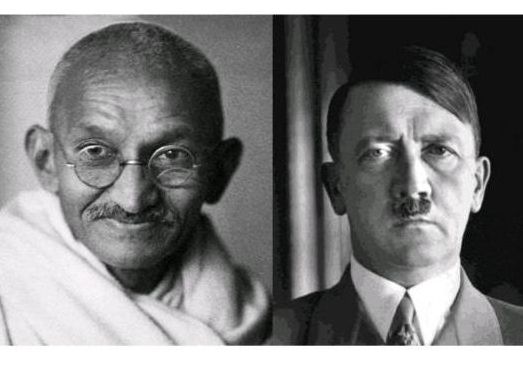
The two lenses through which Gandhiji and Hitler respectively viewed the world had absolutely nothing in common. Therefore, as the intended communication, the letter would have had no effect. Logic forces one to that conclusion.
The British were not by any means ‘peacemakers’; they had been sniping at Germany for many decades. They had at least two reasons to block the letter: (1) It might have even a small chance of having its intended effect, and (2) It might create a new and inconvenient diplomatic alliance between Germany and the leaders of India’s freedom struggle.
In general, when two persons meet whose ‘view lenses’ have nothing in common, they can only engage in polite nothings. Of course they can still shake hands, smile from ear to ear, and pose for photo-ops — but those photo-ops are intended to communicate with entirely different groups.
Another crucial point is this: Do the two parties to a communication understand equally well the logical and psychological intricacies involved? A party that falls short on this understanding will get played by the other; any blind spot or weakness on his part will be exploited.
It follows that, unless there is at least a small core of commonality in the ‘view lenses’ of the two parties, there is no point in them even attempting to communicate. Without such a common core, they will only talk past each other.
Bad as that sounds, the situation can be worse. A negative prior assessment of each party by the other causes every statement made by one to be misconstrued by the other. On both sides, negative prior assessments then worsen — and the parties end up being farther apart after the attempted communication than they were before.
It sounds idealistic and nice to hear: Can’t we resolve our differences by talking frankly about them? But in the absence of trust, this approach does not work.
Unless each party believes that the other wishes to achieve some progress, communication does not work. When schools and colleges teach ‘communication skills’, there is an implicit, underlying assumption of trust. In the cynical real world, however, trust is not the rule but the rare exception.
When parties are from two different cultures, negative biases are far more likely, and finding a core commonality of views is even harder. Culturally learned communication skills and cues do not work across cultures.
During WWII, Netaji Bose went to Germany and later received military help from Japan. But one cannot be certain that the Indian contingent were not viewed by the Japanese as ‘cannon fodder’. It has been established definitively that the Japanese infantry used foreign civilians and POWs for target practice and bayonet practice (see here).
In older cultures, ‘ancient wisdom’ is valued because it has long stood the test of time. Or else why would anyone even consider it ‘wisdom’? Any such ‘ancient wisdom’ must prove itself by tackling successfully the challenges of the present.
Assume that one party to an attempted communication claims possession of ‘ancient wisdom’. The other party is not in any awe of the alleged wisdom — but is, on the contrary, skeptical. No core commonality in ‘view lenses’ is then possible. Honest communication is ruled out — which is not to say that pretence, shady deals and photo ops cannot happen. Shady deals in fact rely on intentionally misleading communication.
An example: It has been witnessed time and again that ‘the west’ uses the ‘universal values’ of ‘freedom and democracy’ only as bait, to fool the masses everywhere. Say an educated and sincere Indian — justifiably mindful of the country’s true ‘universal values’ — is speaking with a ‘westerner’. It is likely that any assertion by the Indian of his ‘universal values’ will be viewed by the ‘westerner’ merely as bait. Not only is that the common ‘western’ practice — but it is also precisely what many so-called gurus in India do 24×7!
This conclusion is therefore inescapable: Discretion and caution are the most universal of values — regardless of whether they have been so noted in any ancient book!😉
[Acknowledgements: Photographs of Gandhiji and Hitler courtesy Wikipedia.]
