All posts by Naresh

Intrigued by age-old questions ... which are not yet answered!

LEARNING THE BLUES

by Naresh Jotwani

Before proceeding, please listen to this song Learning the blues at least once.

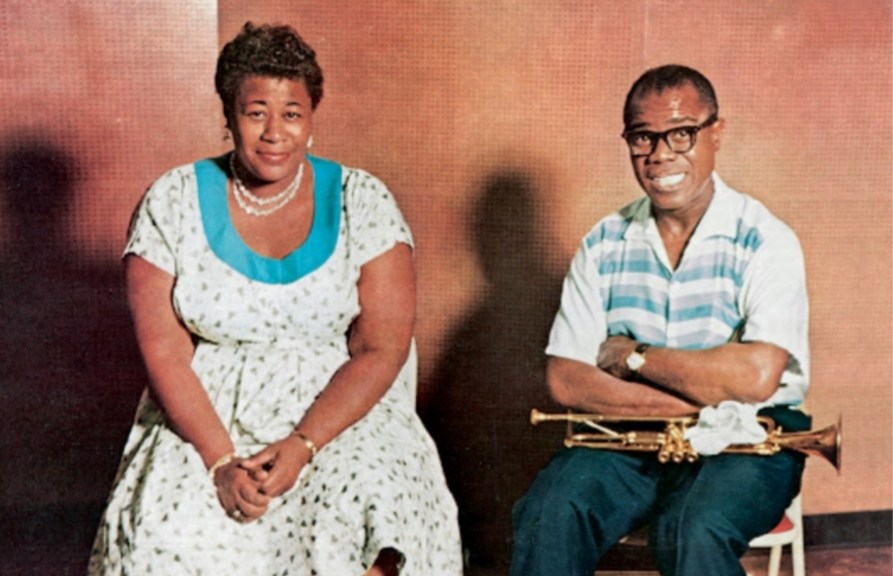
The duet is sung by Ella Fitzgerald and Louis Armstrong (‘Satchmo’), two of the greatest American singers and musicians of all time. The two were legends of their time, basically the middle few decades of the previous century. While this post focusses on the song itself, some more information about these two amazing individuals is provided here.

The song is about heart break, about a loved one leaving. But the two singers are not sighing, longing or pining for each other; there is not the slightest hint of that sentiment in the song. Rather, the song suggests that the two singers have been through their own personal, painful heart breaks. They are in the same boat, so to speak, in the process of facing and overcoming the pain.

That explains why we have selected this particular song to introduce Ella Fitzgerald and Louis Armstrong. Heart break is a common problem in any society, and we usually assume that ‘adults’ know how to deal with it. But if we reflect upon the phenomenon, we realize that it often has long-lasting effects on personal life, family life, professional life and so on. In that sense, heart break is a largely unsolved problem.

So why not listen to these two superb artists work their magic on that timeless theme?

Needless to say, this is a beautiful song, sung by highly talented artists, who are accompanied by a superb band; the introductory trumpet is by the great master Louis Armstrong himself.

The song says that, from the tragedy of heart break, the natural growth path for an individual is towards ‘learning the blues’. In other words, the path is towards transcending individual tragedy to something greater.

[It is worth noting here that Gautam Buddha listed ‘suffering’ as the first of the Four Noble Truths.]

A mere two generations earlier, the grandparents of these two incredibly gifted musicians must have endured cruel, inhumane slavery. But clearly their spirit never died, proving once again – if proof is needed! – that the spirit of the oppressor dies, but not that of the oppressed.

With spirit and creativity of the highest order, these two and many other black artists changed the course of western music – away from the formalized culture of stuffed shirts and stiff, wooden poses, behind which lurked cruelty, arrogance and hatred. Ella and Louis were far more spirited and alive than the arrogant stuffed shirt types could even dream of being.

We may compare this song about heart break with one sung by K. L. Saigal, from the movie ‘Shah Jahan’:

जब दिल ही टूट गया, हम जी के क्या करेंगे?

No doubt this song can be enjoyed in the abstract, but clearly anybody behaving in that manner in real life will be treated with pity and contempt. Besides, what kind of a ‘king of the world’ – ‘Shah’ of the whole ‘Jahan‘, no less! – would whine in that manner upon going through a mere heart break? Should such a guy be allowed anywhere near a throne?

There ought to be a law against whining.

We are justifiably proud of our ancient heritage. However, in today’s chaotic world, only might is right. Our priceless ancient heritage, in and by itself, cannot magically solve today’s problems. That priceless heritage works only when it is translated into concerted practical action, so as to be of good use in facing the myriad challenges of today’s life. The proof of the pudding is in the eating – not in its beautifully printed recipe.

Neither Ella Fitzgerald nor Louis Armstrong claimed much book knowledge or ancient wisdom. Individually, they faced huge challenges in their lives, and overcame all of them. They showed that challenges must be faced with an indomitable spirit; book knowledge and ancient wisdom are optional. All the practical knowledge that Ella or Louis needed, they picked up along the way, without missing a single beat of their glorious music, so to speak.

We close with a few words of advice from Ella Fitzgerald:

Just don’t give up trying to do what you really want to do. Where there is love and inspiration, I don’t think you can go wrong.


Postscript: For a song by Ella and Louis with a hugely vibrant, exuberant mood, listen to Stomping at the Savoy. This is a song for occasions before a heart break – or after one has come out in one piece at the other end!

[Photo credit: Verve Records] 

ABOUT ELLA FITZGERALD AND LOUIS ARMSTRONG

by Naresh Jotwani

Words can never do justice to individuals who are larger than life.

Why? Firstly, and very obviously, because language is a mere impression or expression of reality, but not reality itself. Secondly, the writer is also limited in his own capacity of imagination and comprehension. A ten litre vessel cannot hold a hundred litres of water. In the same way, an average person cannot fully comprehend – or ‘take in’ – the life and accomplishments of a giant such as Ella Fitzgerald or Louis Armstrong.

With that in mind, this very brief introduction should be seen as a tribute.

Ella and Louis lived their life with immense talent, spirit, energy, struggle and determination. With their music, they won the hearts of hundreds of millions, and changed the character of western music. These two, and other musicians of that genre, had a major transformative effect on western society.

So why are these two not treated as historical figures? Well, quite simply because historians choose to concern themselves more with wealth, power, dynasties, war et cetera. Scholarship today has become highly specialized and divided into tight compartments. Thus a ‘musicologist’ may miss the impact of a whole class of talented musicians on popular culture. In the writer’s humble opinion, however, Ella Fitzgerald and Louis Armstrong had more influence on people and culture in the US than did most US presidents.

Both these artists rose from very humble backgrounds, and through difficult childhood. The photos below from their from younger years may be compared with the theme picture above from their prime years; the comparison reminds us of their decades of total commitment to lively, innovative music.

Ella (left); Louis with mother (right)

Over time, Louis Armstrong came to be regarded as the Founding father of jazz, while Ella Fitzgerald came to be known as the Queen of jazz. The relationship between them was professional, and full of mutual respect. Both were strong, independent minded individuals, totally committed to their profession. There was never any so-called ‘romantic’ aspect to their relationship.

More information about Ella Fitzgerald and Louis Armstrong may be obtained from Wikipedia, and from the respective two websites here and here. A program produced by Hungarian TV in 1965 (here) shows how popular Louis Armstrong was even in a so-called ‘eastern block’ communist country.

[Photo credits: Verve Records, Wikipedia, ellafitzgerald.com]

Help someone in distress … But HOW?

by Ashok Saraf, Tapasya Kollimarla, Keshav Vaze, Jayram Daya, Naresh Jotwani

Distress can be of different kinds. It may arise due to material needs not being fulfilled, or from situations beyond one’s control, such as acts of nature. Distress may be due to a man-made situation, like a conflict or an accident. Or it may arise from  emotional stress, such as fear of failure, loss of a near one, illness, heart-break or a negative emotion.

Continue reading Help someone in distress … But HOW?

WEST OR EAST?

by Jayram Daya, R. Srinivasan and Naresh Jotwani

Several centuries after the decline of the Romans, the major European naval powers had laid the groundwork for a culture of colonization and exploitation. By that time, the Anglo-Saxons had established themselves in England. Their belief in ‘God, Gold, and Glory’ spurred British colonization in the New World, altering history forever. The other European naval powers who likewise set out to colonize and exploit were Spain, Portugal, France and the Dutch.

Continue reading WEST OR EAST?

Village, Small Town or City?

by Jayram Daya, R. Srinivasan and Naresh Jotwani

The choice of where one would live, work and settle down is never a simple or an easy one. Many people spend their entire lives in their hometown, never having to make that choice. Many others have that decision forced upon them by economic or other compulsions.

Nevertheless, the factors that might typically affect such a choice can be explored in an objective manner. At least that is what we have attempted here!

Continue reading Village, Small Town or City?

THE LEGAL SYSTEM AND HARMONY

by Jayram Daya, R. Srinivasan and Naresh Jotwani

In a few previous posts, we have discussed harmony of mind, body and spirit (here), harmony with nature (here) and — somewhat indirectly — harmony in a society (here). On the last point, harmony in a society, clearly the legal system also plays a big role. The ideal, of course, would be that the legal system adds to societal harmony. But can this ideal ever be attained, given human nature and the working of a modern society?

The legal system is a practical, administrative necessity in a modern society. Without a proper legal system, a modern economy cannot function. Harmony figures nowhere in the stated goals of an economist or a business titan; and only a very simple-minded person would assert that the legal system adds to societal harmony.

Thus we have a seemingly unavoidable tradeoff here between two goals — economic performance and societal harmony — both of which are desirable for a society. Three views are presented here to get you thinking!

Continue reading THE LEGAL SYSTEM AND HARMONY

COOPERATION, COMPETITION – OR BOTH?

by Jayram Daya, R. Srinivasan and Naresh Jotwani

Cooperation and competition both play a role in our collective life — sometimes more of this, sometimes more of that. However, a self-styled ‘capitalist’ sees red at the mere mention of cooperation, whereas a self-styled ‘communist’ argues for forcefully imposing cooperation on the whole society.

Suppose we put all such western ideologies to one side and ask: What does our lived, empirical reality say?

Continue reading COOPERATION, COMPETITION – OR BOTH?

NATURE DEMANDS HARMONY

by Naresh Jotwani

We often hear the phrase survival of the fittest, when it is used with reference to evolving natural eco-systems. However, for two reasons, this usage can mislead. One reason is that survival may be wrongly taken to mean the survival of an individual, whereas its correct meaning is the survival of a species. The second reason is that the central, crucial criterion of fitness is left unspecified in that phrase.

Continue reading NATURE DEMANDS HARMONY

HARMONY OF MIND, BODY, SPIRIT

by Jayram Daya, Guest author

Preface: Here our good friend Jayram Daya shares with us the story of a deeply personal journey of recovering his health. On this journey, he discovered the huge importance of attaining full harmony of mind, body and spirit. Further along the same journey, he discovered the unity of all existence.

It is truly a remarkable story! Pain is turned to gain!

Continue reading HARMONY OF MIND, BODY, SPIRIT

WELLNESS, PREVENTION OR CURE?

Last week a discussion took place within our WhatsApp group on the subject of wellbeing, quite broadly defined. Members shared their views, based on their own knowledge and experience. Overall, the members’ views, when arranged together, took the form of a panel discussion. Needless to say, in a discussion among friends, nobody had a personal axe to grind. Views were shared in the hope that a thoughtful reader may find something useful in them.

It is in that spirit that are we presenting the views here.

Continue reading WELLNESS, PREVENTION OR CURE?