
by Jayram Daya, R. Srinivasan and Naresh Jotwani
Several centuries after the decline of the Romans, the major European naval powers had laid the groundwork for a culture of colonization and exploitation. By that time, the Anglo-Saxons had established themselves in England. Their belief in ‘God, Gold, and Glory’ spurred British colonization in the New World, altering history forever. The other European naval powers who likewise set out to colonize and exploit were Spain, Portugal, France and the Dutch.
To gain power and wealth, these powers brutally exploited and sometimes even exterminated indigenous populations. With aristocrats and royals ruling in Europe, land and gold were the ultimate symbols of power and wealth. Present-day countries in Africa and in the western hemisphere were founded on the basis of such colonization and exploitation, perpetuating a culture of ruthless western greed and materialism.
Western political and religious institutions, including the Church, have always provided overt or tacit support for these policies, and have had a huge impact on global values and priorities. The papal decree Inter Caetera even sanctioned the colonization, enslavement, and exploitation of people who today belong to the Global South. However, this poisonous and exploitative western ideology afflicts the world even after five centuries, as financial exploitation has now been added to the armoury of the West. Fortunately, institutions such as BRICS have been founded to counter precisely such exploitation.
The so-called western elites have affected not only western societies, but also the course of human history. After the recent scientific and industrial advances, cosmopolitan cities became beacons of wealth and desire, luring people with the promise of prosperity and fulfilment. Using media advertising that reinforces a culture of endless consumption, the West creates a culture of desire and growing debt in the average breadwinner.
In effect, the western approach has imprisoned many people in a cycle of materialism and debt, wherein the desire for wealth leads to an endless but increasingly futile endeavour. This has resulted in a paradox, whereby wealth itself can become a burden, precluding or at least greatly obstructing a contented and creative life in older years.
The following is a true-life incident narrated by Jayram:
I am overcome with emotion as I recall an encounter that left an indelible mark on my heart. During the dark days of Apartheid, a wealthy and influential white man, once the mayor of our town, found himself alone in his ‘golden years’; his marriage had ended, and he tried to fill the void with a newfound passion for antiques. Then he hired a young Hindu girl from our community, who selflessly cared for him in his final days.
Years later, his estranged wife, now a humble and compassionate soul, walked into my factory, seeking plastic ware for a noble cause. As we spoke, I was taken aback by her dedication to serving the poor through a soup kitchen at her church. Her comments sparked something deep within me, and I happily donated all the items she needed.
She asked me why I would not accept money. Was I not a Hindu and a businessman?
I replied, ‘Our gods may have different names, but they are the same. You call him Jesus, I call him Krishna.’ Her eyes welled up with tears, and she embraced me tightly, transferring her energy and warmth to my very being. At that moment, the racial divide that once separated us melted away, and I felt a divine connection that stayed with me.
This experience taught me that, in old age, love, respect and true happiness are paramount. I appreciate this because life has taught me that, even in the most difficult circumstances, there is always hope and love to be found.

The following is narrated by R. Srinivasan:
In 2006, I had a very interesting experience when I was in Melbourne, Australia for a week on a professional engagement. In the evening, back in my hotel room after dinner, I would surf local TV channels to learn about Australian society, looking for insights not available from the media back home.
On one channel, the presenter was discussing what ails the Australian male population as they grow old. He said young Australian adult males grow up in an environment of projecting a macho image, with emphasis on vigorous physical activity, drinking beer in a pub, and generally enjoying a boisterous, hedonistic life. As men grow older, they continue to believe that that is the only right way to live, and they try to re-live the life of their younger years. However, they have by then become physically incapable of living like a younger person. That realization drives them to frustration, and sometimes even depression, with no clear idea of how to come out of the difficulty.
The speaker then pointed out that the main reason for this situation is that the men were never taught about the role of spirituality in their lives, which would have helped them to make a smooth transition to the next stage of life. This point made me sit up and pay more attention to the guy. I realized that he was indirectly referring to the eastern way of life, where focus on spiritual matters is as important as that on material aspects. It is this focus which helps people deal with the dilemma of growing old.
This experience happened at the fag end of my own professional life as a consultant. I was asking myself, at the age of 56, how much longer I should go on working, earning good money and name, but not getting any inner satisfaction. I would wonder how well I would handle the transition when my time came.
The transition happened two year later, with a major health crisis arising from my nomadic life, travelling all over India and even other countries. The health crisis put an end to that kind of existence and forced me to look inwards. Realizing that my time had come for Vanaprastha, I started mentoring youngsters, particularly those who were starting out as entrepreneurs. I found that the change – from the pursuit of wealth to withdrawing from the pursuit and focussing on my inner satisfaction – became a great stabilizer in my life.
Later, I observed what was happening in the life of youngsters, which was dramatically different from my own life in younger days. I noticed that while many youngsters started earning high salaries at a young age, their personal disillusionment led them to gravitate towards The Art of Living, Isha Foundation and such. In these places, the audience had youngsters from developed countries, and also from Indian metro cities.
I realized that our traditional education system, which emphasizes spiritual dimensions as much as aiming at material success, has now been replaced by focus only on material success. Such one-sided education does not address the dissonance experienced by people later in life, which requires a deeper understanding of life.
The following is narrated by Naresh Jotwani:
About a year ago, I had the good fortune of interacting with a senior academic person, in his sixties, serving as Dean (Engineering) at an Australian university. He had obtained his first engineering degree in Bangladesh, his home country, and postgraduate degrees in the west. The topic of our interactions was Australia’s roadmap to achieve freedom from fossil fuels over the coming decades. The gentleman had an excellent grasp of all the technical issues, and answered all my questions very clearly.
Judging from his commitment, grasp and energy level, I would guess the gentleman has several more years of satisfying professional life ahead of him. There was not the slightest hint of any pessimism in him, and he was most definitely NOT afflicted by the kind of confusion which Srini has written about. So where do this gentleman’s spiritual strength and wisdom derive from? One must assume that they come from Islam, and also from his upbringing and early education in Bangladesh.
I have no doubt that we would find something similar in the professional life of Shri E. Sreedharaan, ‘Metro Man of India’, who was professionally active well beyond the age of eighty. No doubt he would have derived his spiritual strength and wisdom from Sanatana Dharma, and from his upbringing in Kerala. His strength and wisdom had a huge positive impact on his professional life — and on the country’s vital urban infrastructure.
For millennia, the East had a vibrant ancient culture rooted in knowledge which encompassed medicine, astrology, wealth creation and science. In China and India, this rich heritage thrived in a largely harmonious society, where agriculture and crafts flourished, the products of which were exported to many countries. The ancient ‘silk route’ was used by traders for millennia and, in parallel, sea trade between India and West Asia also thrived.
Compared to the West, India had a far more holistic understanding of an individual’s life, with its four natural stages: studies (Brahmacharya), righteous duty in family life (Gruhastha), withdrawal towards solitude and detachment (Vanaprastha), and renunciation (Sanyasa). As a result, societal norms have evolved in India that stress community and family ties, and offer a more sustainable and fulfilling approach to aging.
A stable financial situation can, and should, result in true peace of mind and happiness, as also appreciation and gratitude for the blessings one has received. However, people whom we may call ‘wealth worshippers’ do not or cannot do this, focussing instead on what is lacking, and always finding fault in the surroundings, family, society, and even country. This is in fact the trap of Maya into which they seem to fall, prioritizing material possessions and such things over genuine, meaningful relationships and personal growth.
In this context, we may cite what Jesus said: Man shall not live on bread alone, but on every word that comes from the mouth of God. If we equate ‘every word that comes from the mouth of God‘ with eternal, timeless truth, then are we not very close to the Indian view?
The effects of undiminished attachments on an individual who is getting older have been depicted schematically in the chart shown below.
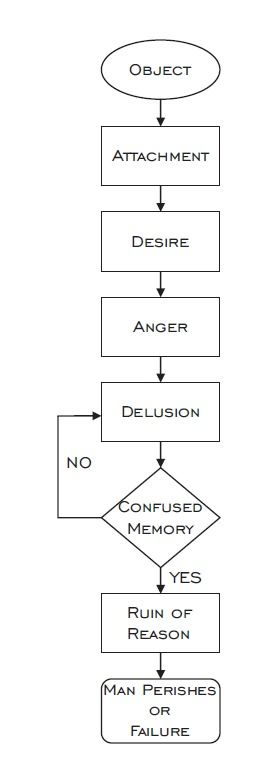
From attachment to sense objects follow desire, anger and delusion. That cycle continues as long as an individual has the required will and energy to somehow continue to ‘obey’ the attachments – that is, be driven by the desires. With age, however, as memory, reason and the physical body weaken, failure of one kind or another must follow, just as night follows day.
Is there a way out of this existential dilemma of so-called ‘aging’? This is a perfectly secular question, which requires a rational answer.
The sages of India showed that, at a certain stage in life, it is possible to withdraw from attachment to sense objects – and thereby avoid the cycle of anger and frustration. They showed this in a perfectly objective, rational and secular manner. They did not invoke any mystical mumbo jumbo; nor did they preach, prescribe or dictate to anyone to behave in a certain way. They simply laid out the facts of human life in a rational and lucid manner. Every individual must make his choices as he deems right, based on his understanding, without feeling any compulsion or coercion.
This achievement of the sages of India is unique and priceless in today’s chaotic global situation.
What happens when a mind turns away from attachment to sense objects?
The answer can almost be read off the chart above. When a mind turns away from such attachments, it avoids the ensuing cycle of dissatisfaction and discontent. So then what happens instead? The mind finds fulfilment in relationships and personal development – such as through a creative hobby. This focus tends to be neglected in a mind that is strongly attached to pursuing happiness exclusively through sense objects.
This is why Vanaprastha and Sanyasa need to be seen as a rational approach in the latter stages of life. Thereby a person turns away from further material pursuits, and obsession with material possessions, in favour of something of far greater value – namely, true peace and creativity.
In that sense, Vanaprastha and Sanyasa represent a winning choice – not a grudging, whining defeat. The individual can freely make that choice, based on his own clear understanding, without any external preaching or coercion.
We trust the reader has found much food for thought in these points of view. We will be happy to hear from readers their own well-considered points of view, based on their own varied experiences in life. Shorter messages can be posted as comments, but we will also consider longer messages as possible posts on the blog.
Readers who appreciate this type of writing are requested to share this post with like-minded friends.
 seeker-of-root-causes
Apropos the piece by RS wherein he says,
The speaker then pointed out that the main reason for this situation is that the men were never taught about the role of spirituality in their lives, which would have helped them to make a smooth transition to the next stage of life. This point made me sit up and pay more attention to the guy. I realized that he was indirectly referring to the eastern way of life, where focus on spiritual matters is as important as that on material aspects. It is this focus which helps people deal with the dilemma of growing old.
“
I was reminded of a poem by Shri Govind Karandikar (ज्ञानपीठ पुरस्कार विजेता, popularly known as विंदा):
तुकोबाच्या भेटी शेक्सपिअर आला
तुकोबाच्या भेटी
शेक्सपिअर आला
झाला तो सोहळा दुकानात
जाहली दोघांची उराउरी भेट
उरातले थेट उरामध्ये
तुका म्हणे “विल्या,
तुझे कर्म थोर
अवघाची संसार उभा केला”
शेक्सपिअर म्हणे,
“एक ते राहिले
तुवा जे पाहिले विटेवरी”
English translation:
Shakespeare came to meet तुकोबा (संत तुकाराम).
It was a ceremony in the shop
They met as if they were nurturing a long-standing friendship
Their thoughts got mutually transmitted when they hugged each other
Tukaram said, “Willya, (in Marathi it is a custom to distort the names in a friendly manner) your deeds are indeed great!
You have created a canvas which encompasses the world!
Shakespeare says, “But One thing remained, What you saw standing on a brick”
(Explanation: There is a mythological story that God Vitthal (विठ्ठल) was pleased with the devotion of his भक्त पुंडलिक and came to visit him. Pundalik, who was busy attending to his parents, asked Him to wait and threw a brick at Him to stand on. The विठ्ठल मंदिर in Pandharpur has the idol depicting Him standing on a brick)
——————————-
शेक्सपिअरच्या थोरवीला जराही धक्का न लावता विंदांनी शेक्सपिअरच्या नाटकांमधल्या अध्यात्म ह्या उणिवेवर बरोब्बर बोट ठेवलं आहे. शेक्सपियरच्या नाटकांमध्ये इतर सर्व भावना होत्या, पण अध्यात्म नव्हतं.
.. Vinda (विंदा) has subtly brought out the lack of spirituality in Shakespeare’s plays without diminishing his greatness. Shakespeare’s plays had all the other emotions (Love, lust, anger, hate, jealousy, mercy, pride, vengeance).
But no spirituality.
—————————–
As RS has said:There IS a difference.
A stark difference!
LikeLike
Naresh
History has seen empires rise and fall repeatedly. There is no doubt that power cyclically changes as the West’s dominance begins to decline this century. Roman, British, and Mughal empires rose to great power only to succumb to internal decay and eventual collapse. The American empire will likely follow this trajectory, as its decline has already manifested itself. Due to the East’s increasing influence, it is prudent to diversify and not rely solely on the dollar. As the global economy shifts, we must prepare for the fall of the West. Fortunately, institutions such as BRICS have been established to counterbalance the exploitation that is often associated with imperial decline, thus providing hope for a more equitable future. As stated, “Fortunately, institutions like BRICS have been established to fight exploitation of this kind.”
LikeLike
while agreeing with the premise that with aging, the wise way is the way of renunciation, especially materialistic pursuits, I do not think the dichotomy is between East & West.
It is between the materially rich, and the materially poor individual.
The East is full of ancient wisdom, but so is the West.
The difference lies in the personal, material wealth of the Western world. Unless you live a life of awareness, it is easy to drown in materialism.
As we see progressive increase in wealth in Indian households, do we not see the propensity to drown in materialism increase.
Wisdom and folly thrive everywhere in the world. It would be wise to recognize the good everywhere you see it, and try and stamp out our biases, both overt and covert, wherever they exist – even if it is within ourselves.
A spiritual, loving humane life is within reach of everyone, but habits – especially of the material kind – are hard to conquer, unless you attack them with devotion.
LikeLiked by 2 people
Pradeep cant agree with you more. That is our observation too and hence we realised that time to fet the next generation across the world not to get exclusively trapped in the allure of materialism. Thanks for your comments.
LikeLiked by 1 person