Tag Archives: Life

WEALTH AND POWER IN KALI-YUGA

by JAYRAM DAYA

[Editorial note: Consider this ‘eternal mathematical truth’: (a+b)×c = a×c + b×c. A mathematician, centuries ago, must have divined and articulated this truth. Surely however, in commerce, this truth held even in earlier epochs. Suppose you had two bags of fruit, with a given unit price. Then you got the same total price (a) by adding the two weights and pricing the total, or (b) by weighing and pricing the bags separately and then adding the two prices. Surely that bit of commercial truth is also eternal, regardless of what mathematicians say!

Eternal truths are timeless. They held in ages past, hold today and will continue to hold in whatever future we may be heading into. Today Jayram Daya has selected for discussion one such eternal truth; not a mathematical truth, but a societal one, from Srimad Bhagwatam.

Read, reflect and enjoy!]

वित्तमेव कलौ नृणां जन्माचारगुणोदय: ।
धर्मन्यायव्यवस्थायां कारणं बलमेव हि ॥ २ ॥

In Kali-Yuga, wealth alone is considered the sign of a man’s good birth, proper behaviour and fine qualities. Law and justice are applied only on the basis of power.

Shrimad Bhagwatam (verse 12.2.2).

The wisdom of this ancient verse reads less like scripture and more like a headline in 2026. The verse says that in Kali-Yuga,  merit is replaced by the sheer weight of a wallet, and justice becomes a commodity rather than a right.

When we examine the current global landscape, especially through figures like Donald Trump, these truths are not remote or subtle; they are glaring and unmistakable; they have become the defining characteristics of our era.

Wealth as the new definition of virtue

The verse states that wealth alone will be considered the sign of a man’s good birth, proper behaviour, and fine qualities.

Modern society views net worth as a sign of competence.

Consider Trump. His entire political identity has been built on his branding as a ‘billionaire dealmaker’. For millions, his wealth served not merely as an asset but as a moral credential, pre-authorizing his leadership irrespective of his dubious ethical record. The Bhagavatam states clearly that external wealth is mistaken for personal qualities.

Global ‘success’ culture

We see this everywhere, from the glorifying of ‘grind culture’, to influencers who hawk luxury and excess dressed up as insight and wisdom. The elevation of wealth as the sole criterion of ‘good fortune’ results in devaluation of character, and redirection of societal ambition almost exclusively towards  wealth acquisition and ostentation.

Power as the arbiter of law

The second half of the verse is even more striking: Law and justice is applied only based on one’s power.

In 2025 and 2026, we have watched as the legal systems of the world’s most powerful nations struggle to hold the elite accountable. Whether it is through endless litigation, the ‘transactional’ appointment of judges, or the use of political office to bypass indictments, the message is clear: Justice is no longer blind; it now measures worth by the size of one’s balance sheet.

A ‘might-makes-right’ world

International relations have returned to a pure transactional approach. The use of power, financial and military, is now used to unilaterally reshape borders and trade agreements, to the exclusion of any international dharma. When a figure uses his position to ‘rule the world’ through sheer force of personality and purse, the rest of the world often feels silenced, unable to challenge the brute strength, बलम, on display.

Reclaiming the servant

Srimad Bhagwatam does not just diagnose the disease; it reminds us of the cure. The danger isn’t money itself, but its elevation to the status of god. The more money becomes the ‘ruthless master’, the more humans become ‘asses’, in working tirelessly for superficial and meagre rewards.

One way to challenge the Kali-Yuga mindset is to restore the integrity of money. It requires a return to substance over status and dignity over dominance.

Heed the warning

The verse in question does not condemn modernity; rather, it explains modernity. In 2026, the verse reads like a prescient, sober diagnosis of a world of inverted values. Donald Trump’s position of power illustrates how easily wealth can be covered up as virtue and power as righteousness. That is the true meaning of Kali-yoga.

The challenge, then, is not political but civil. Restoring justice depends on reaffirming that money is a means, not a badge of legitimacy, and that power must operate within the law rather than stand above it. Without this correction, the eternal truth continues to unfold, not as prophecy, but as lived reality.

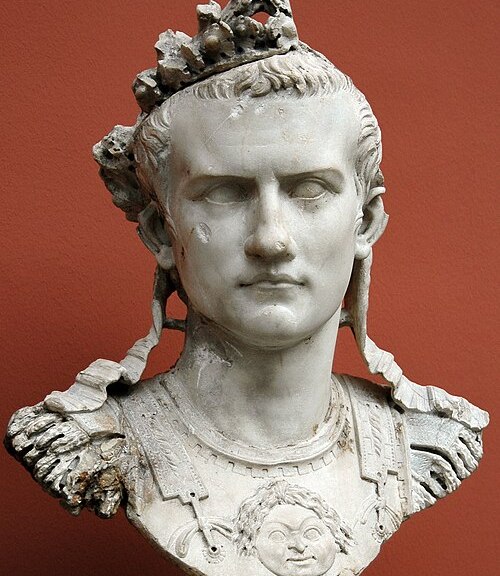
[Image: Bust of Emperor Caligula of Rome; photograph by Sergey Sosnovskiy; courtesy: wikimedia]

Two Powerful Words

by Naresh Jotwani and R. Srinivasan

Should I try to be a moral person? A nice guy? A law-abiding citizen? Or would that turn me into a loser? An impractical dreamer?

How do I become a winner? A realist?

Can I become a cunning operator in a philanthropist’s garb? Is that option available to me? Or only to some billionaires? Is greed really good – as they say on Wall Street?

Questions, questions … and more questions! But – alas! – no clear answers!

In the hope that a discussion around such questions would be of interest to everyone, we attempt here an exploration of some basic issues.

Continue reading Two Powerful Words

Whither democracy?

by Jayram Daya

Editors’ foreword:

Today we see tensions and conflicts in many parts of the world, caused by internal strife and external pressures, which affect the lives of ordinary people. The former colonial order has disintegrated, giving way to countries which – in theory – are sovereign. A sovereign country should aim to improve the lives of her citizens, but the country is also affected by pressures from the outside. Meanwhile, the old colonial powers find their own backyards affected by globalization, leading to backlash against immigrants. Western power is being challenged by emerging nations which have come together to resist hegemony and improve the lives of their citizens.

We all seem to be visited by that famous Chinese curse: May you live in interesting times!

In this context, our friend Jayram Daya shares his insights from his hometown of Standerton in South Africa. Readers are invited to post their views as comments.

Continue reading Whither democracy?

Help someone in distress … But HOW?

by Ashok Saraf, Tapasya Kollimarla, Keshav Vaze, Jayram Daya, Naresh Jotwani

Distress can be of different kinds. It may arise due to material needs not being fulfilled, or from situations beyond one’s control, such as acts of nature. Distress may be due to a man-made situation, like a conflict or an accident. Or it may arise from  emotional stress, such as fear of failure, loss of a near one, illness, heart-break or a negative emotion.

Continue reading Help someone in distress … But HOW?

WEST OR EAST?

by Jayram Daya, R. Srinivasan and Naresh Jotwani

Several centuries after the decline of the Romans, the major European naval powers had laid the groundwork for a culture of colonization and exploitation. By that time, the Anglo-Saxons had established themselves in England. Their belief in ‘God, Gold, and Glory’ spurred British colonization in the New World, altering history forever. The other European naval powers who likewise set out to colonize and exploit were Spain, Portugal, France and the Dutch.

Continue reading WEST OR EAST?

Village, Small Town or City?

by Jayram Daya, R. Srinivasan and Naresh Jotwani

The choice of where one would live, work and settle down is never a simple or an easy one. Many people spend their entire lives in their hometown, never having to make that choice. Many others have that decision forced upon them by economic or other compulsions.

Nevertheless, the factors that might typically affect such a choice can be explored in an objective manner. At least that is what we have attempted here!

Continue reading Village, Small Town or City?

THE LEGAL SYSTEM AND HARMONY

by Jayram Daya, R. Srinivasan and Naresh Jotwani

In a few previous posts, we have discussed harmony of mind, body and spirit (here), harmony with nature (here) and — somewhat indirectly — harmony in a society (here). On the last point, harmony in a society, clearly the legal system also plays a big role. The ideal, of course, would be that the legal system adds to societal harmony. But can this ideal ever be attained, given human nature and the working of a modern society?

The legal system is a practical, administrative necessity in a modern society. Without a proper legal system, a modern economy cannot function. Harmony figures nowhere in the stated goals of an economist or a business titan; and only a very simple-minded person would assert that the legal system adds to societal harmony.

Thus we have a seemingly unavoidable tradeoff here between two goals — economic performance and societal harmony — both of which are desirable for a society. Three views are presented here to get you thinking!

Continue reading THE LEGAL SYSTEM AND HARMONY

COOPERATION, COMPETITION – OR BOTH?

by Jayram Daya, R. Srinivasan and Naresh Jotwani

Cooperation and competition both play a role in our collective life — sometimes more of this, sometimes more of that. However, a self-styled ‘capitalist’ sees red at the mere mention of cooperation, whereas a self-styled ‘communist’ argues for forcefully imposing cooperation on the whole society.

Suppose we put all such western ideologies to one side and ask: What does our lived, empirical reality say?

Continue reading COOPERATION, COMPETITION – OR BOTH?

NATURE DEMANDS HARMONY

by Naresh Jotwani

We often hear the phrase survival of the fittest, when it is used with reference to evolving natural eco-systems. However, for two reasons, this usage can mislead. One reason is that survival may be wrongly taken to mean the survival of an individual, whereas its correct meaning is the survival of a species. The second reason is that the central, crucial criterion of fitness is left unspecified in that phrase.

Continue reading NATURE DEMANDS HARMONY

WELLNESS, PREVENTION OR CURE?

Last week a discussion took place within our WhatsApp group on the subject of wellbeing, quite broadly defined. Members shared their views, based on their own knowledge and experience. Overall, the members’ views, when arranged together, took the form of a panel discussion. Needless to say, in a discussion among friends, nobody had a personal axe to grind. Views were shared in the hope that a thoughtful reader may find something useful in them.

It is in that spirit that are we presenting the views here.

Continue reading WELLNESS, PREVENTION OR CURE?