by JAYRAM DAYA
[Editorial note: Consider this ‘eternal mathematical truth’: (a+b)×c = a×c + b×c. A mathematician, centuries ago, must have divined and articulated this truth. Surely however, in commerce, this truth held even in earlier epochs. Suppose you had two bags of fruit, with a given unit price. Then you got the same total price (a) by adding the two weights and pricing the total, or (b) by weighing and pricing the bags separately and then adding the two prices. Surely that bit of commercial truth is also eternal, regardless of what mathematicians say!
Eternal truths are timeless. They held in ages past, hold today and will continue to hold in whatever future we may be heading into. Today Jayram Daya has selected for discussion one such eternal truth; not a mathematical truth, but a societal one, from Srimad Bhagwatam.
Read, reflect and enjoy!]
वित्तमेव कलौ नृणां जन्माचारगुणोदय: ।
धर्मन्यायव्यवस्थायां कारणं बलमेव हि ॥ २ ॥
In Kali-Yuga, wealth alone is considered the sign of a man’s good birth, proper behaviour and fine qualities. Law and justice are applied only on the basis of power.
Shrimad Bhagwatam (verse 12.2.2).
The wisdom of this ancient verse reads less like scripture and more like a headline in 2026. The verse says that in Kali-Yuga, merit is replaced by the sheer weight of a wallet, and justice becomes a commodity rather than a right.
When we examine the current global landscape, especially through figures like Donald Trump, these truths are not remote or subtle; they are glaring and unmistakable; they have become the defining characteristics of our era.
Wealth as the new definition of virtue
The verse states that wealth alone will be considered the sign of a man’s good birth, proper behaviour, and fine qualities.
Modern society views net worth as a sign of competence.
Consider Trump. His entire political identity has been built on his branding as a ‘billionaire dealmaker’. For millions, his wealth served not merely as an asset but as a moral credential, pre-authorizing his leadership irrespective of his dubious ethical record. The Bhagavatam states clearly that external wealth is mistaken for personal qualities.
Global ‘success’ culture
We see this everywhere, from the glorifying of ‘grind culture’, to influencers who hawk luxury and excess dressed up as insight and wisdom. The elevation of wealth as the sole criterion of ‘good fortune’ results in devaluation of character, and redirection of societal ambition almost exclusively towards wealth acquisition and ostentation.
Power as the arbiter of law
The second half of the verse is even more striking: Law and justice is applied only based on one’s power.
In 2025 and 2026, we have watched as the legal systems of the world’s most powerful nations struggle to hold the elite accountable. Whether it is through endless litigation, the ‘transactional’ appointment of judges, or the use of political office to bypass indictments, the message is clear: Justice is no longer blind; it now measures worth by the size of one’s balance sheet.
A ‘might-makes-right’ world
International relations have returned to a pure transactional approach. The use of power, financial and military, is now used to unilaterally reshape borders and trade agreements, to the exclusion of any international dharma. When a figure uses his position to ‘rule the world’ through sheer force of personality and purse, the rest of the world often feels silenced, unable to challenge the brute strength, बलम, on display.
Reclaiming the servant
Srimad Bhagwatam does not just diagnose the disease; it reminds us of the cure. The danger isn’t money itself, but its elevation to the status of god. The more money becomes the ‘ruthless master’, the more humans become ‘asses’, in working tirelessly for superficial and meagre rewards.
One way to challenge the Kali-Yuga mindset is to restore the integrity of money. It requires a return to substance over status and dignity over dominance.
Heed the warning
The verse in question does not condemn modernity; rather, it explains modernity. In 2026, the verse reads like a prescient, sober diagnosis of a world of inverted values. Donald Trump’s position of power illustrates how easily wealth can be covered up as virtue and power as righteousness. That is the true meaning of Kali-yoga.
The challenge, then, is not political but civil. Restoring justice depends on reaffirming that money is a means, not a badge of legitimacy, and that power must operate within the law rather than stand above it. Without this correction, the eternal truth continues to unfold, not as prophecy, but as lived reality.
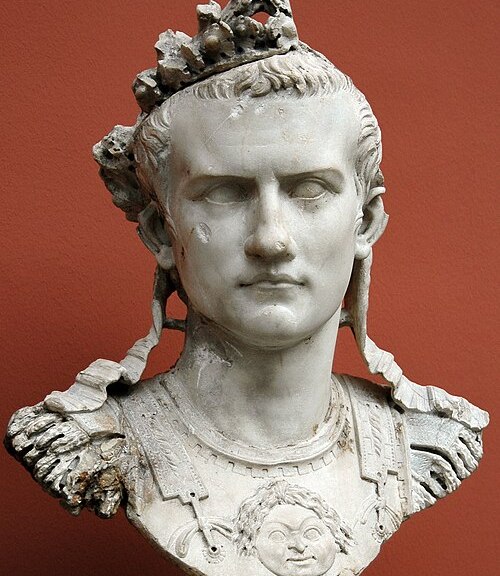
[Image: Bust of Emperor Caligula of Rome; photograph by Sergey Sosnovskiy; courtesy: wikimedia]





 seeker-of-root-causes