
by Naresh Jotwani
Foreword:
Based on an earlier post on this blog (here), Keshav Vaze raised a very interesting question. His question prompted me to look for a rational answer, in the sense defined below. Some prior knowledge of Spinoza and of Vedant helped in formulating the answer, which I hope the reader will find to be of interest.
Keshav:
As an exercise in logic, can we arrive at Santana Dharma – that is, eternal law – through a point of view which is not anthropocentric?
Consider this excerpt from an earlier post:
A broadly accepted list of virtues in our tradition is this: generosity, morality, renunciation, wisdom, perseverance, forbearance, truthfulness, determination, love and equanimity.
According to Spinoza, these concepts of ethics are human-centric, but there is no basis for believing that God — or Nature or some law of Physics — created the universe with humans in mind. In Spinoza’s philosophy, humans are not considered inherently more important than any other part of nature.
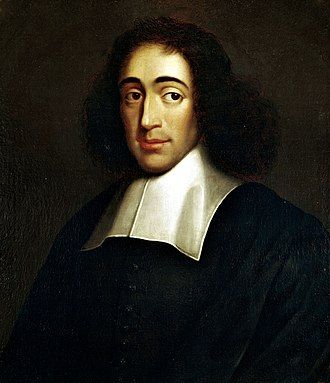
According to Spinoza, true ethical behaviour arises from understanding our place within this unified system and aligning our actions with the natural order. In this way, we can talk rationally about ecology, environmental protection, bio-diversity … et cetera.
Naresh:
[Note #1: The word Vedant below refers to the philosophical foundation of Sanatana Dharma. As K. M. Chandrasekharan clarifies in his book Yogatma (here), this is the path of inquiry rather than the path of surrender, or bhakti. Also, for the present, we take the word life to be synonymous with consciousness.]
Given a consistent set of premises, a rational thought process leads to a conclusion which is inescapable. So if Spinoza (S) and a student of Vedant (V) arrive at different conclusions, their premises must be different. We cannot for a moment imagine that they did not, or do not, know how to reason.
S avoids any human-centric premises. Therefore, he sees virtues as qualities which are in alignment – or harmony – with the natural order. Indeed there is no logical basis to assert that the universe was created with humans in mind, or that it was created for the material enjoyment of humans.
There is nothing whatsoever wrong with that argument. So can we identify the difference between their premises which lead S and V to different conclusions?
Let us make an honest effort to answer that question. The key difference between the premises employed by S and V comes out when we answer the following central question with either YES or NO.
Central question: In trying to understand the universe in a rational manner, should the rational thinker take into account the undeniable fact of consciousness as the primary fact of existence?
Case 1: Answer is NO
In this case, the primary fact of existence is physical phenomena. So one must deduce consciousness as a physical effect of interacting, non-living constituents; that is, electrons, atoms … et cetera. This is what assorted microbiologists, neuroscientists and Elon Musk are trying. While physical constituents are primary, consciousness is merely their bye-product.
Case 2: Answer is YES
In this case, consciousness itself becomes the first premise. If there is no consciousness, there is no perception, no questions, no science … nothing! Physical constituents are then no more than concepts resulting from consciousness interacting with the entirety of existential reality, or ब्रह्म, of which it is a part.
When we speak of life, or consciousness, reasoning ability may or may not be present. So our discussion is not human-centric, as S puts it, but rather life-centric, or consciousness-centric. Consciousness is one across all of life, while its physical characteristics differ, in biology, physiology … et cetera.
[Note #2: If one answers YES to the key question, one faces a follow-up question, namely: Should suffering – and not consciousness – be considered the primary premise, as Gautam Buddha did? For our present purposes, it is immaterial how one answers the follow-up question.]
The central question posed above can also be re-framed in terms of self-knowledge, in which case we end up with sundry questions such as:
- Should the subject take an objective look at itself?
- If a subject takes an objective look at itself, does the subject itself metamorphose to object?
- Should any conclusion reached by the self-inquiring subject be dubbed ‘subjective’ or ‘objective’?
- What are the prerequisites of objective self-knowledge?
To be fair, S probably did not consider such questions. But I do believe that, had he been acquainted with Vedant, he was intelligent and diligent enough to reach the same conclusion that V reaches. There was likely no philosophical interaction between India and Europe at that time. But I do believe that S would have grasped the principles of Vedant with no difficulty whatsoever, once he saw the possibility of consciousness as the primary fact.
Another follow-up question: Since the time of Spinoza, why has no other philosopher, in India or elsewhere, followed up on such important philosophical points?
Answer: In India, the philosophers probably thought they ‘knew it all’; also, they might have been subdued by local unfriendly regimes, or busy cosying up to friendly regimes. In Europe, the best minds were probably busy developing the physical sciences and technologies, exploiting foreign lands and people, amassing wealth, creating self-serving financial and legal systems – and other such ‘highly appealing’ activities!
As a result, what we have today is so-called ‘modern life’ – premised on nobody knows what, and heading to nobody knows where!
More about Spinoza:
The following paragraph is from the Wikipedia entry about Spinoza (here):
As a young man, Spinoza challenged rabbinic authority and questioned Jewish doctrines, leading to his permanent expulsion from his Jewish community in 1656. Following that expulsion, he distanced himself from all religious affiliations and devoted himself to philosophical inquiry and lens grinding. Spinoza attracted a dedicated circle of followers who gathered to discuss his writings and joined him in the intellectual pursuit of truth.
IITB-73 fun quiz question:
Which well-known character in P. G. Wodehouse’s stories, when asked, admitted to reading Spinoza?
 seeker-of-root-causes
Spinoza’s philosophy rejects the notion of a God who is both personal and judgmental. He saw God not as a separate, anthropomorphic being dwelling in man-made temples, but as the totality of existence—manifest in nature, the cosmos, and all living beings. In his view, God is not an outside creator, but the very essence of the universe.
In response to a question about God, Einstein famously replied that he believed in “the God of Spinoza.” This implies that a divine presence does not exist as a personal deity but as the sum of nature’s laws and energies.
As a result of Spinoza’s interpretation, organized religion’s traditional framework is challenged by its dismissal of sin, divine judgment, and ritualistic worship. Instead, he encourages people to find divinity in nature, love, joy, and human relationships. A life of awareness, ethical conduct, and personal fulfillment is more important to him than a punishment by God.
This view aligns with the idea that divinity is not housed in temples but is present in the world around us. Even human emotions are expressions of this divine essence. From Spinoza’s perspective, God should be sought not through scriptures, rituals, or a fear-based belief system, but by living a life filled with love, joy, and connections with others.
Ultimately, Spinoza’s philosophy urges individuals to stop “believing” in God in a conventional sense and instead to recognize and experience the divine as an inherent part of existence, dissolving the boundary between the creator and creation.
I am inspired by Spinoza and Advaita Vedanta and have shared insights on the common law rituals of Sanatan Dharma on my blog: https://unmydharma108.blogspot.com/.
LikeLike