
The co-editors of this blog, Srinivasan and Naresh, have also been running a WhatsApp group named seeker-of-root-causes. Occasionally, a question or a statement is posed to group members, to which members are invited to respond with their own views.
The practical context and significance of today’s topic will be established by this first-person, true life account submitted by Srinivasan:
My own experiences have taught me the enormous scope of karma in practical life, and totally ingrained the concept in my psyche. I will cite just one specific instance here.
When I first started working in Hyderabad in the late 1970s, I got to know a small-time trader in metals. One day he asked me to be a guarantor for a chit fund scheme he was participating in, assuring me that he would easily pay back the money he was borrowing. Trusting him, wanting to be helpful, and not fully grasping the consequences of my action, I agreed and signed as his guarantor. Four years later, as one of the guarantors, I received a court order to pay Rs 33K towards the borrowed amount, including interest and defaulted principal. I had just left my job and started on my own, and I had no money to pay. Thanks to some good friends whom I knew through my social connections, I managed to have the amount reduced to a third of the original claim, since I was only one of three guarantors. Then I had to literally pass my hat around to friends, who jointly bailed me out.
Having been exposed to both karma and its consequences, I learnt two things. One, karma helped me to deal with the situation coolly. Two, while karma creates a situation which looks like a problem, it also shows the path for resolution.
This experience has helped me deal with several experiences of similar nature throughout my life, which I attribute to the clarity I have attained about karma.
To throw light on many such situations which occur in life, the following two questions were posed to members of the seeker-of-root-causes group a few weeks ago.
- Causality pervades the universe. It is the underlying principle behind science. Is there any difference between causality and karma?
- When we learn science, engineering, medicine, management … et cetera … we place our full trust in causality. However, in moral matters, we often invoke karma. But the universe is one. It is not divided into two domains. Therefore causality and karma must be closely related. Question is: How?
Some members replied with their views, which are hereby being presented to a wider audience. Text in this colour represents member views.
Ramchander’s reply to the two questions is succinct and to the point:
Everything is karma. For us it might looks causal. Action-reaction.
Rajeev, on the other hand, differentiates between causality and karma.
I think Scientific ‘truths’ are a set of hypotheses (cause and effect relationships) distinguished by the fact that they are all falsifiable, but have so far not been falsified despite being tested thousands of times. And the scientific and manufacturing community uses them all the time with spectacularly predictable results.
The existence of karma or karmic load is also a hypothesis – but it is not falsifiable. Hence you either believe in it or you don’t. Period. You cannot use scientific methodology to justify your belief.
Deepak doubts that the concept of karma has any basis in reality.
I wonder whether we try to superimpose causal relationships when none exist. The concept of karma is predicated on the unprovable assumption that a creature suffers or benefits only due to its own actions. Nature in fact works at random. When lightning strikes, it is least ‘bothered’ whether it hits a stone, a house, a tree, an animal or a human being.
Arush points out that often confirmation bias is at work, which may cause a person to select only that evidence which supports his belief.
I believe we should also consider that there is a likelihood that there is confirmation bias in play for those who believe in karma. Confirmation bias is human tendency to interpret new data according to their existing beliefs and use the data to rather reinforce their own beliefs than take an unbiased look at the new data.
Personally, many times even I would try explaining something bad/good that happens to me through karma, but there is no way for me to prove that karma is the reason.
Chandrakant says that one must withdraw from the leela of the world, and lose a sense of separate selfhood, in order to be free from intellectual doubts and emotional bondage to karma.
As long as you identify with body, karma will apply.
You owe to parents, family, culture, nation and masters.
You have TV, but you need not see.
You have world leela happening in front of you, but you need not see.
You withdraw from all five senses, now you are.
If you drop you are, you merge with Shiva. You are that.
You merge in whole.
Implies shifting from Doing to Being.
No hurry. Relax.
Srinivasan was the only contributor to point out that the word karma in Indian languages has not one but two distinct connotations.
The discussion started with karma as a causal issue. However, the meaning of karma is also used as referring to duty. The most well-known example of karma as duty, from the Bhagwat Gita, is:
कर्मण्येवाधिकारस्ते मा फलेषु कदाचन।
Hence, as I have understood, the word karma essentially refers to duty by action, while the consequences that arise from it depend on that action being right or wrong. This also helps direct one’s thought for action in the right direction, recognizing that if the action is wrong the consequences also would be wrong. To that extent the logical construct of cause and effect is, in my view, quite different from karma and the fruits of action.
Suman states clearly that karma is an all-encompassing principle – ‘a continuous chain in space and time’. She adds her insight about the prerequisite for an individual to truly comprehend karma. This is the core idea she presents:
Karma is the all-encompassing concept of action and reaction in a continuous chain in time and space. It is inclusive of causality as conceived in Science. It includes the effects of grief, hurt and wounds caused to ‘another’ or ‘others’. That is nothing but insecurity playing upon the ego which is nothing but false sense of separation. Until the ego with its limited contents of consciousness drops its limited identity and becomes one with all, through repeated experiences of samadhi, this sense of separation will continue and the actions will be of a mixed nature.
[Suman‘s full contribution explores several other aspects of karma. She lists the broad categories of karma, as expounded in our tradition, not omitting the crucial observation that ‘karma does not mean fatalism’. In view of the length of her full contribution, we shall post it separately on this blog.]
Naresh, having worked on compiling and minimally editing the contributions, adds the following as an afterthought:
When we think about causality, we usually have a highly over-simplified picture in mind, such as ‘A caused B to happen’. Reality is infinitely more complex. One cause can have multiple effects, as shown below, or multiple causes may show up in one nett effect. The chain of causality is so vast and intricate that it cannot be fully mapped by the human mind.
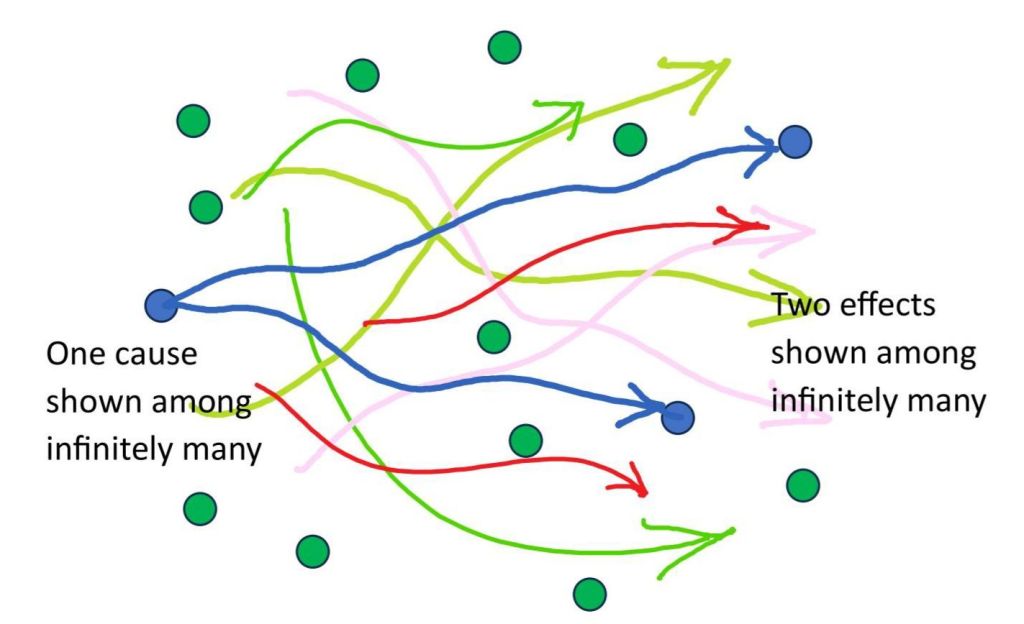
This last observation is now confirmed by the various discoveries in Quantum Mechanics.
Epilogue
Readers on this blog would know that neither causality nor karma are simple concepts to define, explain, justify or refute. These concepts have generated intense debates over millennia, in all parts of the world. All that we hope to do in this blog is to keep a healthy debate going.
We hope that our members’ views would have generated interest, questions and/or answers in readers’ minds. Every individual makes his journey through life on the basis of his own views and understanding. We hope that readers would have benefited somewhat by the views presented.
Full names of our contributing group members are Chandrakant Kale, Ramchander Rao S, Rajeev Saranjame, Arush Tadikonda, Deepak Gupte, R Srinivasan, Suman Rao and Naresh Jotwani. Visitors to the blog are cordially invited to share their own views in the comments section.
[Invitation to guest authors: We are open to thought-provoking articles on any topic other than politics. Please click here for some more information.]
 seeker-of-root-causes
Nature is complex.
Study of nature is Karma.Conclusions are falsifiable, but causality of that is the progress of the human life.
One may believe in things which can not be seen or proved, and may not believe in things which progress the world, but are falsifiable
So ones belief is firm and can lead to causality in his life.
ultimately , it is the concept, which believers and non believers see from opposite directions.
LikeLike
I am more inclined to Naresh’s articulation of Karmic influences; as an accumulation of a multiplicity of prior acts, both mental & physical – leading to a causal result – a consequence of our priors.
we are the cumulative of all our physical and mental lives, and the interactions between the two.
so there is an inherent dynamic that is created. Our lived past creates the present, and the present evolves into the future.
confirmation -and other biases – are inherently flawed. They detract from reality, and create their own sequence of consequences, as they move you away from the equilibrium that is centered in reality or truth.
Philosophically, reducing the impact of ego on our actions, is a powerful metric to realizing the unvarnished truth of our existence.
LikeLiked by 1 person
Very clear articulation, Pradeep!👌
LikeLiked by 1 person
Karma played an important role in my life. You have highlighted that in essence, minimizing the influence of ego on our decisions and behaviors can serve as a potent tool for uncovering the raw reality of our existence.Abinandan
LikeLike
If I may add my two bits: More than “a potent tool”, erasing the ego is an absolute prerequisite for comprehending reality. The stupid ego comes in the way every time!
LikeLike