
Last week, Srini discussed ‘politics of management’. Clearly, almost every agent in that kind of a political environment has hidden motives, or personal agenda. An agent’s personal agenda must be kept hidden, quite simply because it is not aligned with organizational goals; discussing it openly would let the cat out of the bag – and allow others to plot against it.
Srini made it clear that one learns about such politics only when one gets into the real word – which is where one runs into conflicting human motives. Text-book knowledge of management principles cannot impart the valuable lessons which real life experience does. In text-books, human beings are assumed to take up some idealized roles – as ‘director’, ‘manager’ … and so on. Real human emotions and motives cannot be captured in text-books.
Everyday words emotion, motion, motive and mobile have a distant but common Latin root movere, which means ‘set in motion, impel, move’. Physicists and engineers have been grappling for centuries with physical motion and motive power. In parallel, psychologists have tried to understand human emotions, motives and behaviour. Emotions move people. Sometimes emotions drive people to distraction – or even, sadly, to self-destruction; very frequently, emotions drive people to violence.
What happens when a person in an organization nurses a hidden personal motive which is at odds with organizational goals? Of course lip service must be paid to the latter – while calculating inwardly how one would grind one’s own axe. Duplicity, dishonesty, inner conflict and inter-personal conflict are thus intricately woven into the situation when hidden motives abound.
Straightaway, we can conclude that the job of the leader is to deny such hidden motives any space to play out in the workplace. If they are not contained – that is, ‘not nipped in the bud’ – the hidden motives of several persons can get tangled up and become ‘knotty’ problems for the leader. For any clever person with a hidden agenda, outward loyalty shown to the leader or the organization is no more than cover for pursuing his own hidden agenda.
The hidden motives under discussion here are beyond mere physical needs such as hunger, thirst, shelter et cetera. In Srini’s post, the VP whose father wanted him to become CEO did not, we can be sure, face any hardship in terms of physical needs. The same holds true for the other examples which Srini cited. Very often, even when physical needs are adequately met, greed and ambition know no bounds. We are dealing here with psychological needs.
Our ancient sages thought deeply about human nature. They observed that because such psychological needs can never be met, they are the root causes of deep dissatisfaction. Such needs are, in turn, caused by craving, aversion and illusion. These psychological states, in their acute form, impair a person’s ability to make sound judgements. Persons in such a state lose all regard for others, and even for long-term consequences to themselves. In short, these psychological states are the destroyers of clarity.
This basic idea can be brought out by asking: What are the kinds of disturbances that can afflict a still mind, a mind at peace? A quick answer is: Since almost any object in the universe can disturb the stillness, the disturbances which can afflict a mind are infinitely many.
That is a fair enough answer. But our sages dug deeper, and observed that any disturbed mind is afflicted by one or more of: craving, aversion and illusion. The craving, aversion or illusion may be targeted at any object in the universe. Regardless of its object, however, a craving is a craving, an aversion is an aversion, and an illusion is an illusion. A craving for wine is fundamentally no different from a craving for chocolate … and so on.
Thus the fundamental three constituents of a disturbed mind are craving, aversion and illusion. The possible external targets of these disturbances are countless, quite simply because the universe is boundless.
In Indian languages, these three possible disturbances are known respectively as:
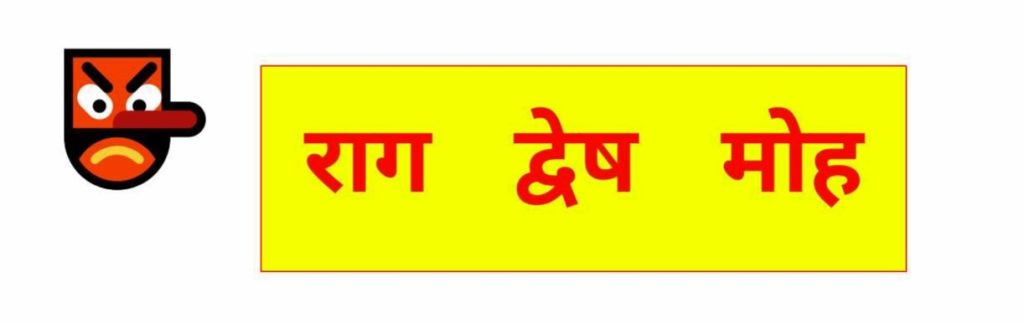
An employee whose mind is steeped in craving, aversion and/or illusion will not commit fully to organizational goals. Possible workplace examples are: obsession with one promotion after another, jealousy of a more competent colleague, and illusion of being a better manager than the boss.
Our management structures are hierarchical. A team leader at one level is himself led by someone else at the next hierarchical level. This structure has implications which we shall try to bring out with a hypothetical example.
Imagine a group of day labourers digging a long ditch for a water pipe. While digging, the labourers sometimes banter, bully, joke, curse, quarrel, make up … and so on. Their foreman, sitting nearby, keeps watch. As long as the work is progressing, he does not interfere; but if he is really upset, someone will be out of a job. The shrewd foreman does not bother to impose too much order on the labourers. His ‘optimum’ strategy is to impose the minimum order required to achieve the daily work quota and get his cut on the wages paid.
What are the motives of the foreman? While the labourers are stuck in their daily grind, the foreman can, to some extent, think beyond the grind. Is he an ‘ideal’ employee for the company he works for? Certainly not. He has to handle ‘workplace politics’ the best he can, while meeting work targets.
The foreman’s manager is sitting in an office twenty kilometres away. He has no choice but to turn a blind eye to the ‘workplace politics’ of the dig site. Unless things go really out of hand, he must judge only the work completed and the cost incurred. He knows that the foreman does not usually apply ‘text-book HR methods’, but he must accept things as they are. Of course he must keep the foreman under check, and certainly not let him stray too much out of line – but neither can he afford to micro-manage the foreman’s work.
The example above is of manual labourers, but human beings are human beings. Even in a group of ‘white collar’ workers, we can expect some degree of banter, bullying, jokes, curses, quarrels, making up … et cetera. So what is the key difference between the dig site and a ‘white collar’ workplace?
‘White collar’ work requires analysis, judgement, application of mind, clear articulation of ideas … et cetera. Accordingly, ‘white collar’ workers are more intelligent, educated and calculating. The nett value addition of ‘white collar’ work, per person per day, is orders of magnitude greater than that of unskilled manual work. With greater value addition goes greater cost of mistakes, since a complex system having a thousand components fails even if one component fails. With more money at stake, politics becomes worse.
Unskilled physical work proceeds even when the mind is somewhat agitated, and work output is directly measurable. Say a group of workers have dug ninety cubic metres instead of a hundred cubic metres. Surely the manager can handle such shortfalls. But the impact of sloppy intellectual work is far greater – and the impact is far harder to measure. The cost of a single software bug, or an oversight in product design, can be HUGE! Time to pass the buck!
The conclusion seems to be that a certain degree of workplace politics is simply unavoidable in a ‘white collar’ workplace. To reduce or minimize its impact on organisational goals, the leader has to be competent, patient, firm … and much more! Not even the globally highest ranked schools of management can teach such ‘practical knowledge’, or impart the required wisdom.
[Speaking of globally highest ranked academic institutions, many unsavoury stories about their own workplace politics have been making the rounds lately! Without any doubt, one must reckon that much more remains hidden.]
Assuming that one cannot simply drop everything and search for a guru in the Himalayas, how does one cope with all this?
Based on the analysis, we throw out the following practical tips – with a strict warning of BUYER BEWARE! While these tips do have a decent probability of working in the long run, a lot depends on their patient and intelligent application. For short term results, one must plunge into workplace politics, figure out the power and money flows, pledge fealty here and there – and watch out for ambushes!
That said, the tips:
• It helps to make long-term plans and a proper SWOT analysis; there is no benefit in being totally caught up in negative workplace politics.
• Higher competence level and a solid record of achievements is needed to achieve long-term goals.
• One must stay clear of politics, playing fair and straight. It helps to build a professional network outside the organization, with timely and discreet hints that one is open to a position of greater responsibility elsewhere.
• Badmouthing even the most untrustworthy characters in the workplace simply gives them the excuse they need to play dirty.
• Large financial liabilities create stress, which can only worsen matters.
• Someone at workplace, or a business associate, may dangle a bait, hoping for a bite. One must not take the bait. One must look carefully at all offers of help, or sweet, solicitous inquiries; and expect no genuine goodwill in the workplace.
• One can even try a fake reverse bait; an honest, sincere person will not only decline the bait, but will signal politely not to waste his time. If that happens, one is likely dealing with an honest person.
• People watch and note what others do. News spreads fast. Does the boss encourage or damp down wrong attitudes? If wrong attitude is damped down over a minor issue, major issues are less likely to arise.
• Firmness in minor political issues saves one from major political issues later. As the English used to say (back when they did say some useful things): ‘A stitch in time saves nine’.
• To understand one’s own position objectively, it helps to take a detached look at workplace politics. Meditation helps, as do Yoga, regular exercise, a creative hobby … and honest introspection.
• Any addiction affects clear thinking.
• A reliable partition is needed between work and family/personal life; that helps to keep family/personal matters on even keel. Negative workplace environment must not impact family life.
Without exception, everybody in an organization has motives in life other than the good of the organization. It would be hypocrisy to deny this fact. But these other motives should not intrude into work. A degree of separation between work and family/personal life must be achieved. While an employee at a lower level of responsibility must, so to speak, ‘shut up and follow the rules’, at higher levels of responsibility, a person needs to develop a professional work ethic.
I can vouch to having been let down by a ‘leader’. That hurt like hell. This person seemed to follow Jack Welch’s dictum about controlling others, as cited by Srini – but he had hidden motives, which later became known to me. The person often took one position in a face-to-face meeting, and an opposite position behind your back. In my opinion – formed in hindsight! – such people are simply incapable of honesty; they think you will never see through the BS.
A workplace is a tangled web of criss-crossing motives. One needs to keep one’s life-thread clear – and achieve one’s goals without getting caught up.


Good article. For any reform, there should be a culture shift. Be it reducing politics or increasing discipline etc. For example, a company hobnobs with politicians and pays political funding and then however much they may preach that honesty is the best policy, it will not work. Because people are not dumb not to see. On the other hand, when I worked in ABB, Zurich, I found there has been very little politics. Transparent policies, evaluations, clear cut career paths, good level of job satisfaction at every level. So majority of people were not hankering after promotions through politics.
Sad to say even in temples (the holiest of places, people are corrupt, indisciplined, beat Qs, a lot of politics). So the actual culture is different from preaching scriptures. In essence, mere knowledge or preaching won’t work. Practice and brining cultural changes will work.
LikeLiked by 2 people
Agree totally! Rote preaching seems to be no more than deliberate misleading, with a hidden motive.
LikeLiked by 1 person
Good article. Only that now I am retired and not stopped teaching ( teaching institutes mega have politics because people have a lot of time), I’m free from all such politics.
LikeLiked by 1 person
Friend, My position is not too different!😉
LikeLiked by 1 person
Naresh
The first chapter of the Bhagavad Gita demonstrates the highest level of human behavior in a crisis. It stimulates people to review and analyze situations when action is required. For those unfamiliar with the Mahabharata, this chapter presents a basic question: “What motivates one to prepare for war and the other to be reluctant before it starts?”
In this chapter, the concerned monarch Duryodhan confides in Dronacharya, listing his armed forces’ strengths, weaknesses, opportunities, and threats. Arjun uses societal norms and personal fears to justify his decision not to fight.
Thus, the key question remains: what truly motivated the conflict?
(This inner confusion caught my feelings after reading the first chapter, unaware of the exact events leading up to the Mahabharata fight of emotion, motion, motivation, and movement.)
Similarly, individuals’ hidden interests within organizations undermine organizational aims. This discussion emphasizes the importance of leaders like Duryodhan in the Gita controlling such hidden urges while remaining focused on organizational goals on the battlefield.
It also includes practical advice for overcoming workplace politics, such as lobbying for competence, honesty, and a clear line between professional and personal lives. This advice is similar to Bhagavan Krishna’s advice to Arjun about a fighter
As Naresh concludes his post, he stresses the importance of not getting caught up in conflicting incentives, recommending that individuals pursue their goals with clarity and honesty. This was also Bhagavan Krishna’s advice to Arjun.
Management politics and motives are a major focus of the Epics of Sanatan Dharm. In Jainism, RAG (राग) refers to basic attachment or love towards a living being or a thing, DWESH (द्धेष) to hatred, and MOH (मोह) to extreme attachment. With these three punch phrases, I can understand why many followers are successful people.
I appreciate Srini’s first-hand experiences as they resonate with genuine organizational values. Abinandan, thank you
LikeLiked by 1 person
“Honesty is the best policy”.
Politics thrives in the dark. Sanitize the workplace by applying consistent, transparent rules.
A reliable boss creates a reliable workplace.
“Actions speak louder than words.”
LikeLiked by 2 people