by Naresh Jotwani
Today the world has literally ‘lost it’ over the word capitalism.
While that may seem to be an overstatement, it can be justified quite easily. Only some clear thinking is needed, founded on words which – unlike capitalism – are rooted in reality.
First of all, any ‘-ism’ cannot be trusted blindly because such blind trust becomes a hindrance to individual growth. Anyone promoting or naively adopting an ‘-ism’ is living ‘in a box’, in which state his individual progress is stunted.
In a society where the basic vocabulary stunts individual progress, can one expect overall well-being? Can one get nectar out of bird feathers?
It is only when one discards ALL ‘-isms’ that one is forced to go back to basics, to reality. No arbitrary concept is then left to cloud one’s view of reality, and a new day dawns.
The word capital derives from the Latin word caput, meaning ‘head’. These two words cannot be taken literally in every instance, but they can reasonably be taken to mean ‘at the head’, ‘important’ … or something similar.
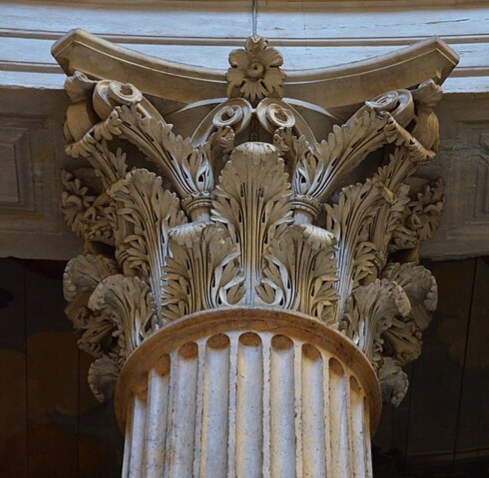
Other common English words which are derived from caput (‘head’) are per capita, decapitate, capital city, Capitol building, capital punishment, and capital as an architectural feature atop a column. None of these meanings have anything to do with capital as surplus wealth. [The feature image above shows a Roman style capital.]
Over time, this word capital somehow came to mean also ‘surplus wealth’. But how? How does the meaning shift from ‘at the head’ or ‘important’ to ‘surplus wealth’?
The surplus produce of a society is real, tangible and important. It helps a society tide over difficult times and build a better future. Good times and bad times come and go. People work hard and produce a surplus – and it is perfectly in order that the surplus helps a society through difficult times. If a farmer stores surplus grain from a good season, he is being a sensible person – not a contemptible ‘capitalist ideologue’.
So what is the dividing line between a sensible farmer and a contemptible ‘capitalist ideologue’?
We suggest that surplus wealth came to be dubbed capital to justify or rationalize its being appropriated away from the wider community — and into the hands of a few self-styled ‘elites’, deemed to be ‘important’.
The use of this word facilitated the sleight of hand involved in the appropriation. The surplus wealth was thereby deemed ‘too important’ to be in the hands of the many who produced it — the hoi polloi or demos.
From this reasoning, it follows that any use of the word capital implicitly acknowledges the reality of the appropriation – and the consequent division of society.
Capitalism as an ideology was needed to justify and to provide a veneer of respectability to the wealth appropriation; and to impose upon society a mindset which sees that ideology as being ‘in the interests of the society’ (see Note 1).
Consequences are inevitable. In a society brainwashed by capitalism, any person’s worth comes to be measured only in terms of the size of his ‘stored hoard’.
A human being has a mix of different qualities such as kindness, wisdom, courage, strength, intelligence, honesty, tact, charm — or the opposites of these. But if one focusses only on a person’s hoard of stored value, nothing else matters; then one wears tight blinkers blinding him to diversity and talent.
One then views life with this single standard of human ‘worth’. One’s understanding and appreciation of life reduces to a single dimension – that of ‘stored hoard’. Kindness, knowledge, art, culture, education, democracy – all that is employed only for show, as veneer or camouflage.
That is a tragedy.
Suppose one hears that a person has a hundred trunks full of jewellery, or a hundred billion dollars of ‘nett worth’. Then it matters not a whit whether the person is kind or unkind, wise or unwise, tactful or tactless et cetera; he may indeed be a horrible, ‘worth’-less person in many ways.
It also does not matter how that capital is acquired. Is it acquired through scams, crime, fraud, pillage, war, patricide or genocide? That is not an issue which bothers fervent devotees of Mammon.
Untold number of persons and communities possess other excellent talents or qualities — skill in agriculture, animal husbandry, music, art, craft, poetry … and so on. But who cares for all that when the almighty Mammon calls?
Hey! What is this gorilla head doing here in our midst?

In a band of gorillas, the ‘head’ gorilla – caput again! – thumps his chest in a show of power. Likewise, in human societies, the size of a stored hoard moves its owner to symbolic but loud and unmistakable chest thumping.
Worship of Mammon, in one form or another, probably set in about five thousand years ago. After that, a steady downward slide in the quality of human societies was inevitable.
A whole new class of humans emerged, who posed as custodians of capital. They called themselves kings, priests, ministers, leaders, treasurers, bankers, financiers, lawyers, fixers … whatever. Instead of working to produce something real, however, they discovered cunning techniques to appropriate the surplus wealth of a society.
A huge new set of professions engaged in handling the ‘wealth’ which arises from surplus produce. Well-being of the primary producers is of no concern of this profession.
The Italian word capo, made famous in the phrase capo di tutti capi, also derives from the Latin word caput. Someone we know believes strongly that ‘Capitalism is no different from gangsterism’. Clearly, simple etymology supports his point quite well.
The right term to describe such human behaviour is not capitalism but ‘limitless greed’. No ideology can cure limitless greed — but any ideology can be used as its fig leaf. Today, the biggest such fig leaf is the ideology of capitalism.
Today the global economic system is quite literally awash in capital worth many trillions of dollars. However, apart from a few islands of ostentation, human life in the rest of the world is full of hardship and/or anxiety. Capital is not coming to help when it is needed the most. On the contrary, in a war, capital destroys itself in order to save itself from destruction!
By what ideologically twisted definition of ‘well-being’ can such a situation be justified?
The reality of the word capitalism – as opposed to the false notion that is worshipped today – is ugly but simple. Capitalism today is greed, or the worship of Mammon — in a newer, slicker, highly verbose disguise.
Any sensible society worth its name would generate surplus wealth. Therefore it needs efficient managers of its surplus wealth. That is a fair description of a class of people who are intelligent, committed, well-paid, honest and highly respected. Their goal should be the future well-being of the society.
But human greed does not allow that. The greedy want to be usurpers of society’s surplus wealth; that last phrase truly describes the true behaviour of today’s capitalists.
Note 1: This likely happened a few centuries ago. Earlier, kings did not need to justify their appropriation of wealth. Their swords did the talking. Of course, ‘religious authority’ would — for a consideration — readily provide a customized fig leaf of ‘theological’ justification.


The glorification of Capitalism is to justify the logic of “survival of the fittest and competent”. It totally ignores the suffering of the majority from essentials for surviving in this cruel planet. The means to enrich can not justify at any point of time in human existence the sufferings of the population at the base of this pyramid.
as Steve jobs said ” Being the richest man in the cemetery does not matter to me. Going to bed at night saying we have done something wonderful that is what matters to me. Money alone is not a matter of success . Creating something valuable, useful and lasting.”
Any Capitalist or industry leader can not honestly admit he has arrived to wipe every tear from every eye. Man made catastrophe like wars with out any justification and leaving the world further fragmented and miserable does not validate the theme of Capitalism.
we need to look at an alternative where efficiency, intelligence and hardwork is recognised and the person rises in the society’s hierarchy for these finer talents and this marks the beginning of an alternative to the ugly capitalism. Needs of humans can be satisfied. Anna dhanam is very noble as any person’s hunger can easily be satisfied by one meal. The challenge is to provide motivation and resources for next meal. Where as greed can never be satisfied and the person spends his last measure of his strength in accumulating!!
West is not having an answer for other countries aping west for ushering in welfare through Capitalism. The shortcomings of other ways of substituting Capitalism requires a new thought and fresh initiative.
Capitalism has failed in restoring human dignity and suffering. To fall back on karma theory to justify suffering is a easy way to black mail the convience of majority who have suffering as a human traits from their cradle to grave.
B.P.Padmanabhan.Padu16d@gmail.com
LikeLike
On first reading, it appears a great, well-thought-out masterpiece. More later.
LikeLike
Thank you, Rajendra!🙏
LikeLike