by Naresh Jotwani
Before proceeding, please listen to this song Learning the blues at least once.
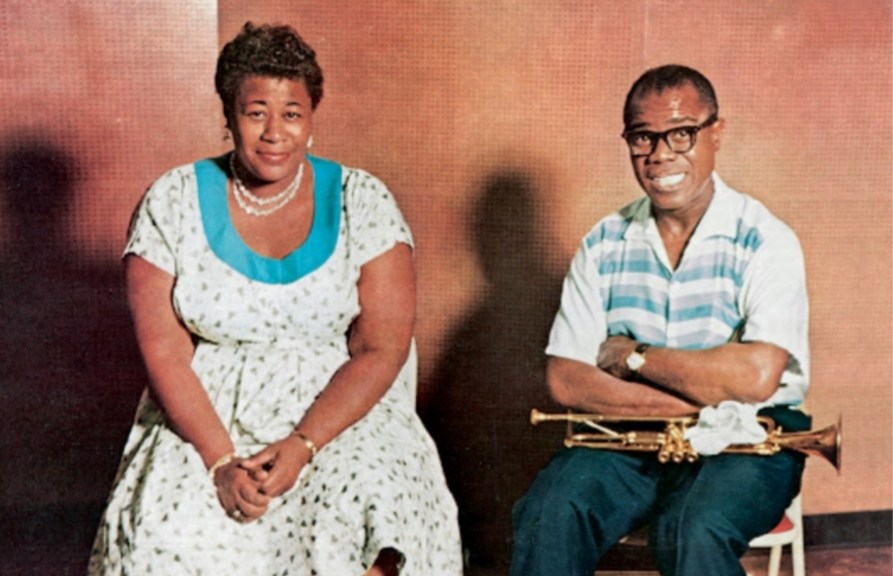
The duet is sung by Ella Fitzgerald and Louis Armstrong (‘Satchmo’), two of the greatest American singers and musicians of all time. The two were legends of their time, basically the middle few decades of the previous century. While this post focusses on the song itself, some more information about these two amazing individuals is provided here.
The song is about heart break, about a loved one leaving. But the two singers are not sighing, longing or pining for each other; there is not the slightest hint of that sentiment in the song. Rather, the song suggests that the two singers have been through their own personal, painful heart breaks. They are in the same boat, so to speak, in the process of facing and overcoming the pain.
That explains why we have selected this particular song to introduce Ella Fitzgerald and Louis Armstrong. Heart break is a common problem in any society, and we usually assume that ‘adults’ know how to deal with it. But if we reflect upon the phenomenon, we realize that it often has long-lasting effects on personal life, family life, professional life and so on. In that sense, heart break is a largely unsolved problem.
So why not listen to these two superb artists work their magic on that timeless theme?
Needless to say, this is a beautiful song, sung by highly talented artists, who are accompanied by a superb band; the introductory trumpet is by the great master Louis Armstrong himself.
The song says that, from the tragedy of heart break, the natural growth path for an individual is towards ‘learning the blues’. In other words, the path is towards transcending individual tragedy to something greater.
[It is worth noting here that Gautam Buddha listed ‘suffering’ as the first of the Four Noble Truths.]
A mere two generations earlier, the grandparents of these two incredibly gifted musicians must have endured cruel, inhumane slavery. But clearly their spirit never died, proving once again – if proof is needed! – that the spirit of the oppressor dies, but not that of the oppressed.
With spirit and creativity of the highest order, these two and many other black artists changed the course of western music – away from the formalized culture of stuffed shirts and stiff, wooden poses, behind which lurked cruelty, arrogance and hatred. Ella and Louis were far more spirited and alive than the arrogant stuffed shirt types could even dream of being.
We may compare this song about heart break with one sung by K. L. Saigal, from the movie ‘Shah Jahan’:
जब दिल ही टूट गया, हम जी के क्या करेंगे?
No doubt this song can be enjoyed in the abstract, but clearly anybody behaving in that manner in real life will be treated with pity and contempt. Besides, what kind of a ‘king of the world’ – ‘Shah’ of the whole ‘Jahan‘, no less! – would whine in that manner upon going through a mere heart break? Should such a guy be allowed anywhere near a throne?
There ought to be a law against whining.
We are justifiably proud of our ancient heritage. However, in today’s chaotic world, only might is right. Our priceless ancient heritage, in and by itself, cannot magically solve today’s problems. That priceless heritage works only when it is translated into concerted practical action, so as to be of good use in facing the myriad challenges of today’s life. The proof of the pudding is in the eating – not in its beautifully printed recipe.
Neither Ella Fitzgerald nor Louis Armstrong claimed much book knowledge or ancient wisdom. Individually, they faced huge challenges in their lives, and overcame all of them. They showed that challenges must be faced with an indomitable spirit; book knowledge and ancient wisdom are optional. All the practical knowledge that Ella or Louis needed, they picked up along the way, without missing a single beat of their glorious music, so to speak.
We close with a few words of advice from Ella Fitzgerald:
Just don’t give up trying to do what you really want to do. Where there is love and inspiration, I don’t think you can go wrong.
Postscript: For a song by Ella and Louis with a hugely vibrant, exuberant mood, listen to Stomping at the Savoy. This is a song for occasions before a heart break – or after one has come out in one piece at the other end!
[Photo credit: Verve Records]


 seeker-of-root-causes